

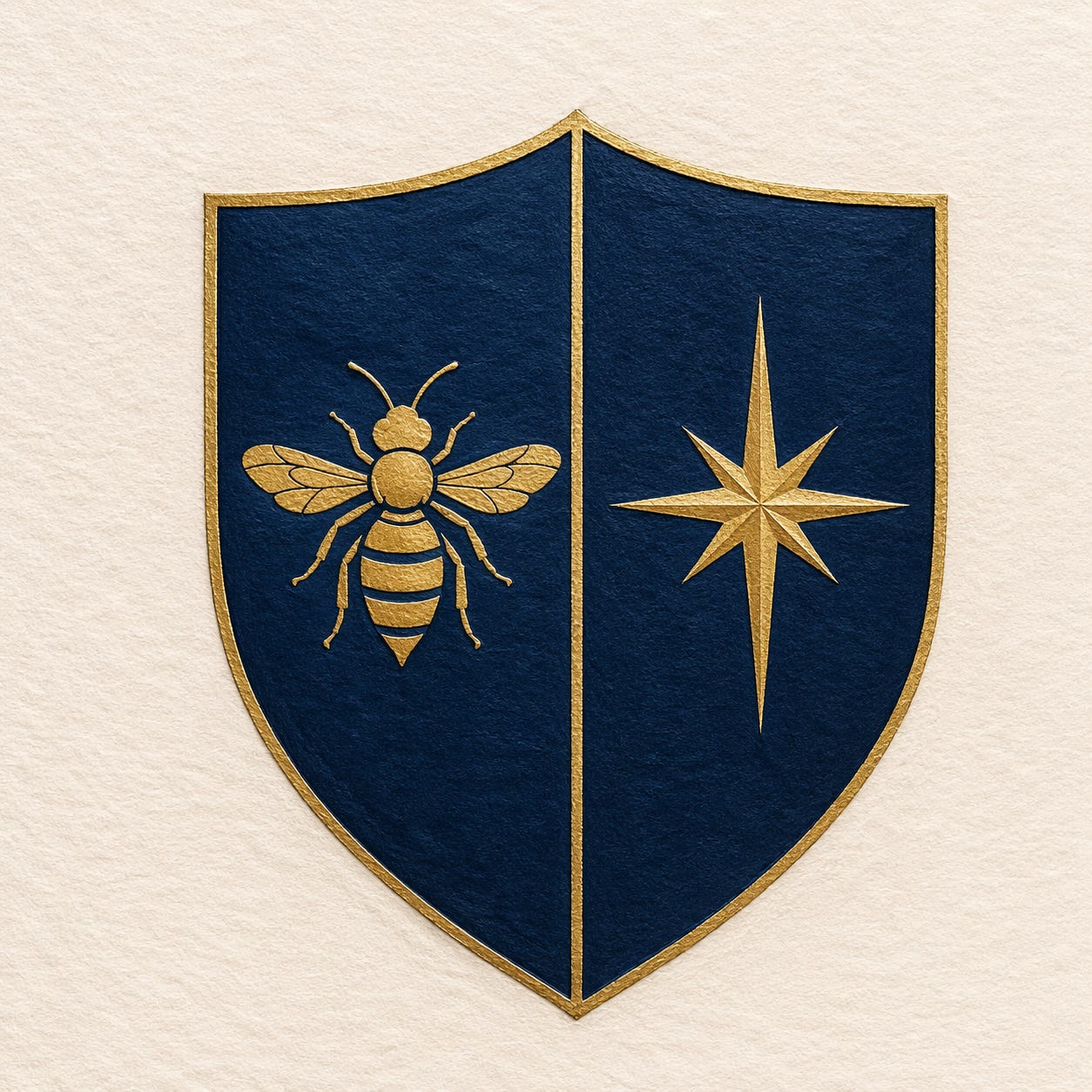
The crest bears two signs: the bee and the star, set against a field of deep blue.
The blue recalls the night sky: the proper horizon of the interior life, where not everything is seen at once, but where light is given for the way. It also suggests the contemplative dimension of life—receptive, attentive, and ordered to what is above—within which all action must find its measure.
The bee signifies a life of patient and ordered labor. In the Christian tradition it has often been associated with preaching and the communication of divine things: as in the account of St Ambrose, upon whom bees settled in his youth, a sign of the sweetness and fruitfulness his words would bear. It evokes fidelity in what is small, and a work that is at once hidden and fruitful—like the word received, tended, and brought forth in due time.
The star speaks of a light not our own. It recalls the traditional image of guidance: a light by which the path is found rather than made. In the Gospel, a star is given to lead the wise toward Christ; and in the tradition of the Church, the Blessed Virgin is invoked as a star who guides safely to Him. It may also be read in a more personal register, in reference to Peter of the Star, a venerated figure of the eleventh century, whose name is associated with the origins of the monastic foundation at Notre-Dame de Fontgombault. Through that lineage, it stands at the source of the monastic life from which this work proceeds.
Together, they suggest the meeting of the active and the contemplative life: effort that is real but not self-sufficient, and guidance that is given and must be followed. The interior life is formed in their conjunction—through labor gradually ordered, and through a light faithfully received—until the way itself is no longer sought as something external, but known in the one who is “the way, and the truth, and the life.”