

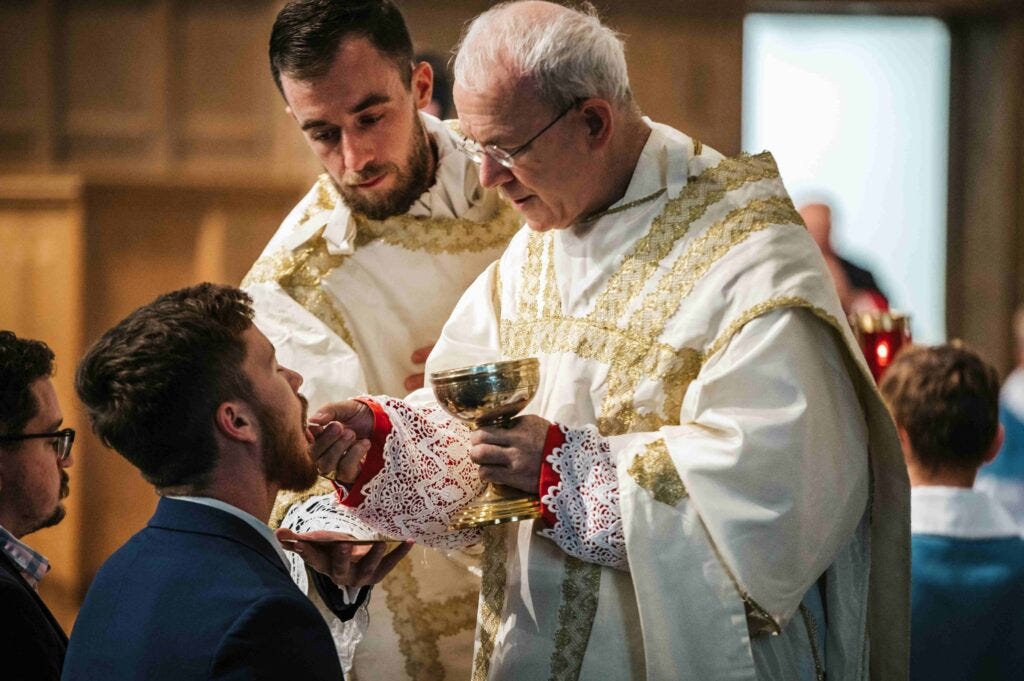
One of the most delicate pastoral questions today concerns Catholics who struggle with addiction: Should they receive Holy Communion after a relapse if they have not yet been to confession?
In many parishes and spiritual conversations, a well-intentioned answer has emerged. Because addiction diminishes freedom, the reasoning goes, the person may not be fully culpable. Because the Eucharist is medicine for the weak rather than a reward for the perfect, abstaining may seem counterproductive. And because canon law allows exceptions to the normal requirement of confession, perhaps regular reception—even after relapse—is not only permitted but encouraged.
This approach is motivated by compassion. It seeks to avoid crushing consciences and to keep struggling Christians close to Christ. Yet compassion, if it is to be truly pastoral, must also be truthful about the nature of the sacraments and the human heart.
Drawing on the theology of St. Thomas Aquinas, moral theologian Brandon Wanless proposes a different and, at first glance, counterintuitive path: for many Catholics suffering from addiction, reverent abstinence from Communion after relapse—combined with a sincere desire for the Eucharist—may be more spiritually fruitful than immediate reception without absolution.
This is not an argument for rigorism. It is an argument for reverence, prudence, and a deeper confidence in how sacramental grace actually works.
The Church’s Constant Teaching: Communion Requires Disposition
The Church has always held two truths in tension.
First, the Eucharist is necessary. Christians are commanded to receive—or at least to desire—the Body of Christ. A Catholic who never approaches the Eucharist deprives himself of a central means of union with Christ.
Second, the Eucharist must be received worthily. From St. Paul through St. Thomas Aquinas and the Council of Trent, the Church has insisted that reception in the state of grave sin is not healing but harmful. It does not unite the soul to Christ; it contradicts the reality being received.
Aquinas is blunt: the only thing that strictly prevents reception of the Eucharist is mortal sin. To receive knowingly in that state is not merely ineffective—it is sacrilege. And even when mortal sin is absent, Aquinas insists on reverence, devotion, and charity as proper dispositions. Communion is never automatic.
This teaching remains intact in modern canon law. Catholics are obliged to refrain from Communion when conscious of grave sin—unless a truly grave reason exists and confession is impossible.
Why Some Counsel Immediate Reception After Relapse
Pastors who encourage Communion after relapse usually rely on three claims.
1. Addiction Diminishes Responsibility
The Catechism explicitly acknowledges that habit, psychological factors, and compulsion can lessen culpability. Addiction is often cited as a paradigm case. If the relapse is not fully voluntary, perhaps it is not mortally sinful.
2. Canon Law Allows Exceptions
Canon 916 permits Communion without prior confession when there is a grave reason and no opportunity for confession, provided the person has perfect contrition and intends to confess as soon as possible. Some argue that repeated relapse and the difficulty of frequent confession make this exception practically applicable.
3. The Addicted Person Needs Eucharistic Grace
Perhaps the most emotionally compelling claim is that withholding Communion deprives the person of precisely the grace he needs to overcome addiction. Isn’t the Eucharist “medicine for the sick”?
Each of these points contains truth. But none of them, Wanless argues, is sufficient to justify a habitual pastoral policy of post-relapse reception.
Addiction, Freedom, and the Limits of Mitigation
Aquinas offers a nuanced moral psychology that is often lost in contemporary discussions.
He distinguishes between sins of weakness and sins of habit or malice.
A sin of weakness arises from overwhelming passion. The will is impaired, reason is clouded, and culpability may be reduced.
A sin from habit, by contrast, is one that flows easily and willingly from a settled disposition. Here culpability is often greater, not less.
The difficulty is that addiction can involve both. A person may genuinely resist, fall through weakness, and repent immediately. At other times, the same person may act with premeditation, indulgence, or resignation.
For Aquinas, this means that addiction cannot be treated as a blanket excuse. Some relapses may indeed lack full consent. Others may not. Moreover, even when individual acts are not fully culpable, a lingering attachment to the behavior can still distort one’s relationship to God and the sacraments.
This is why the Church has traditionally treated grave matter as mortally sinful unless clearly shown otherwise—not out of harshness, but out of pastoral realism.
The Canonical Exception Is Truly Exceptional
Canon law’s allowance for Communion without confession was never meant to become routine. Historically, it exists primarily for priests who must celebrate Mass and consume the sacrament they consecrate.
For laypeople, “grave reason” refers to extraordinary circumstances: danger of death, serious public scandal, or severe defamation of character. Ordinary embarrassment, interior distress, or fear of standing out at Mass generally do not qualify.
If abstaining from Communion is always interpreted as scandalous, that signals not a canonical problem but a loss of Eucharistic culture.
The Forgotten Power of Desire
Here is the heart of Wanless’s argument—and the most neglected aspect of modern sacramental practice.
According to St. Thomas Aquinas, the grace of a sacrament can be received through desire alone.
This is not a concession for those who “miss out.” It flows from the very power of the sacraments as instruments of Christ. Just as one can receive the grace of baptism through desire, one can receive Eucharistic grace through spiritual communion—that is, through faith-filled longing for Christ in the sacrament.
Aquinas goes so far as to say:
All Christians are obliged to receive the Eucharist spiritually.
Sacramental reception is ordered to and perfected by spiritual reception.
One can be united to Christ and grow in charity without physically receiving Communion, provided there is genuine desire.
This means the claim that abstinence deprives the addicted person of grace is simply false. Grace is not blocked by reverence. It is blocked by presumption.
Prudence, Reverence, and the Path of Healing
The question, then, is not merely: May I receive?
It is: What is the more reverent and healing response right now?
For many struggling with addiction, reverent abstinence can:
preserve awe for the Eucharist,
prevent the sacrament from becoming a coping mechanism,
sharpen moral clarity,
foster humility rather than entitlement,
and intensify desire for confession and conversion.
None of this requires withdrawal from Mass. On the contrary, Aquinas insists that even those who do not receive should fully participate, adore, and desire the sacrament.
Mercy Without Presumption
Wanless does not propose a rigid rule. He explicitly leaves room for pastoral discernment. There may be rare cases where immediate reception is fitting.
But as a general pastoral orientation, he offers this Thomistic wisdom:
When disposition is uncertain, reverent abstinence joined to sincere desire is often more fruitful than sacramental reception presumed as a right.
In an age anxious to prove God’s mercy, this approach trusts that mercy does not require us to lower our reverence for the sacraments. It asks us instead to believe something more demanding and more hopeful: that Christ is not withheld from those who long for Him, even when they must wait to receive Him sacramentally.
Bibliographic Note and Access
The argument summarized above is drawn from a recent scholarly article:
Wanless, Brandon L. “Addiction and the Reception of Holy Communion: Pastoral Guidance Informed by the Theology of St. Thomas Aquinas.” Antiphon: A Journal for Liturgical Renewal 29, no. 3 (2025): 196–230. Published by The Catholic University of America Press.
DOI: 10.1353/atp.2025.a978467.
The article appears in the latest issue of Antiphon, which is now available online.
All members of the Society for Catholic Liturgy have free digital access to every issue of Antiphon through Project MUSE. Access details are available on the Society’s website:
https://liturgysociety.org/journal
For readers interested in a careful, Thomistically grounded treatment of one of today’s most sensitive pastoral questions, the full article is well worth reading in its entirety.