

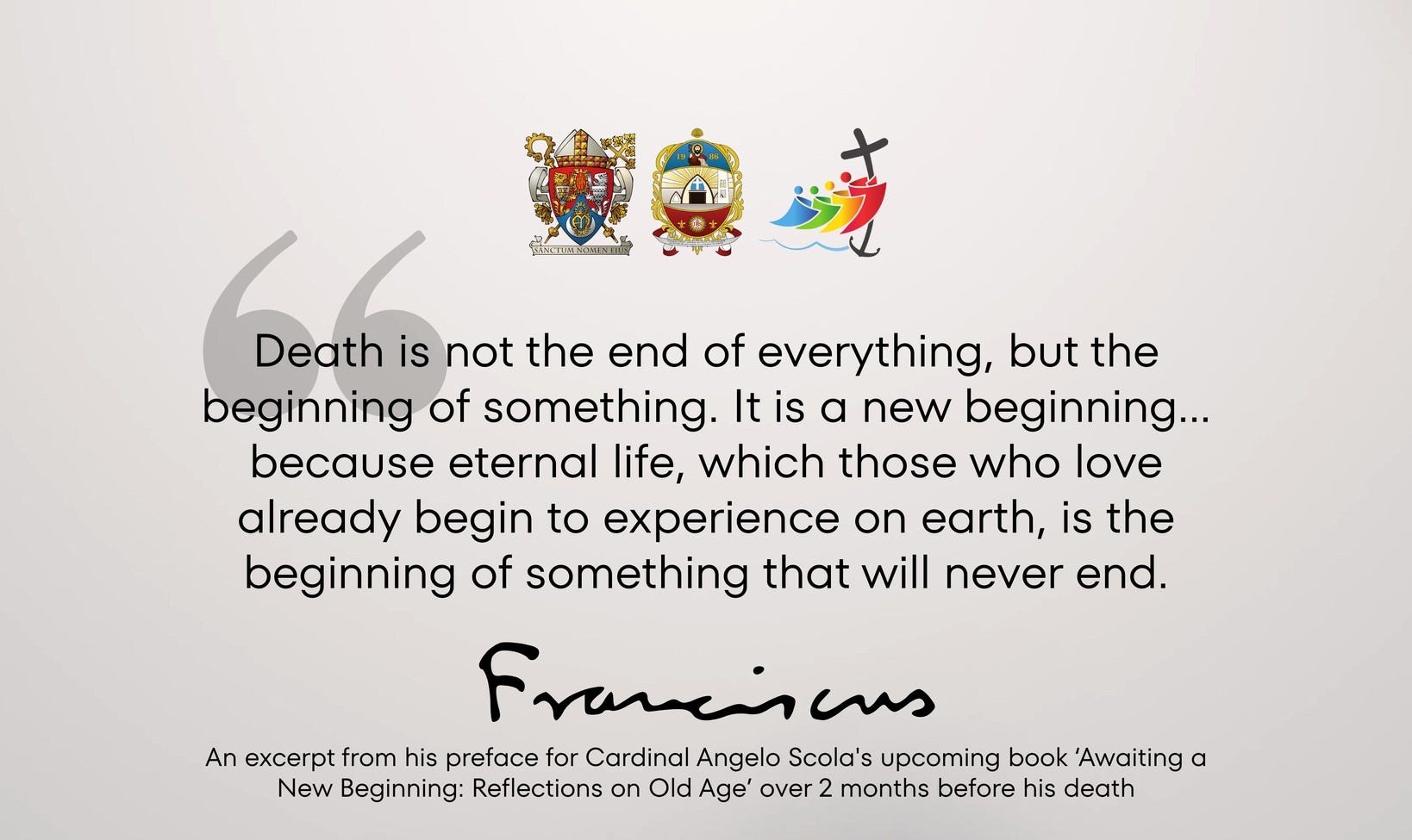
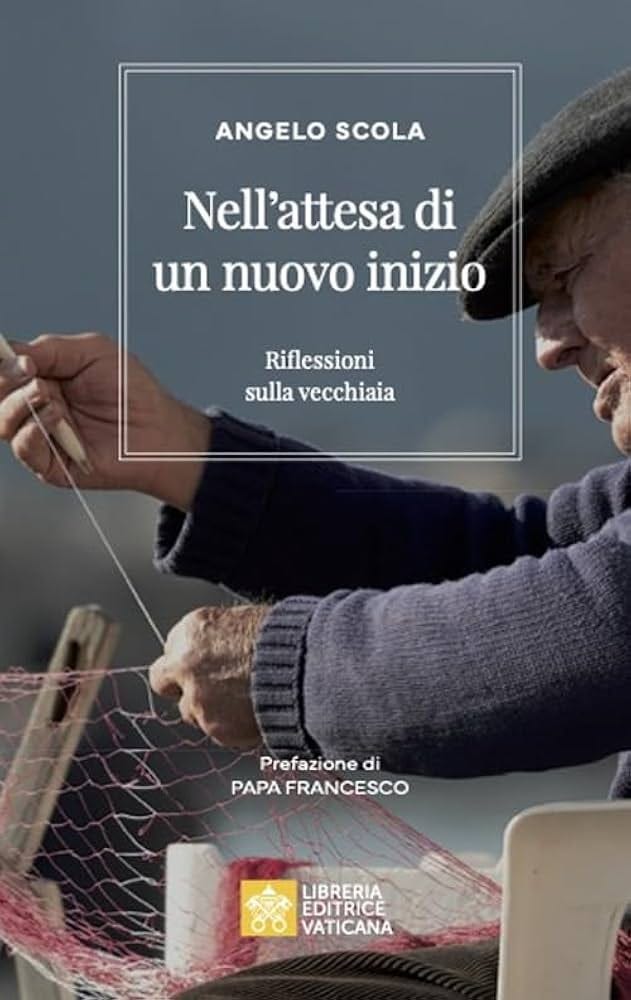
A few days after his death, a foreword written by Pope Francis appeared in bookstores. It had been composed early in 2025 for a book by Cardinal Angelo Scola on old age. There is something providential in the timing: a reflection on aging and death, written by a man who had just passed through both. A voice from the grave, as it were.
What struck me most was not simply the conclusion—“death is not the end of everything, but the beginning of something”—but the way Francis arrives there.
He begins with a refusal that is increasingly rare:
we must not be afraid of old age… we must not fear becoming old.
There is a kind of honesty here that cuts against the habits of our time. We live in a culture that avoids the word old almost instinctively. We soften it, disguise it, replace it with gentler expressions. But Francis insists that this softening is not harmless. To refuse to name something is already to misunderstand it.
And so he restores the word:
Old age means experience, wisdom, discernment, slowness, the capacity to listen.
In other words, it names not a diminishment of life, but a change in its form.
This is an important point, because most of our anxiety about aging does not come from the reality itself, but from the way we interpret it. We tend to see it only as loss: loss of energy, of beauty, of possibility. And these losses are real. They are not illusions.
But they are not the whole truth.
There is a deeper movement taking place—one that is easy to overlook precisely because it unfolds slowly. As life advances, what once carried us begins, little by little, to recede. What was immediate becomes difficult; what was effortless requires effort; what once defined us no longer does so in the same way.
The temptation is to resist this, or to deny it.
But if one does not resist it—if one allows it to speak—another meaning begins to emerge.
We are being led away from what cannot last.
This is not how we usually think about life. We imagine growth as accumulation: more strength, more experience, more identity. But there comes a point when growth takes another form. It becomes a kind of simplification, even a stripping away.
Francis touches this when he writes that the real question is not whether we grow old, but how we grow old. One can live this time “with resentment,” or one can receive it “as a grace.”
That word—grace—is decisive.
Because it suggests that this passage is not merely natural, but meaningful.
Even on a purely human level, one can see that aging demands a transition. What was once outward becomes inward. What was once spontaneous becomes deliberate. One moves, almost without noticing, from being someone who is seen to someone who sees; from seeking to be understood to learning how to understand; from needing to be loved to becoming capable of loving more quietly and more freely.
This is not a loss of life. It is a deepening of it.
But Christianity goes further.
It does not simply say that aging has value. It says that it has direction.
The gradual weakening of the body, the narrowing of possibilities, even the experience of fatigue and limitation—these are not random. They participate in a larger movement: the loosening of our hold on what is passing.
We begin, often unwillingly, to discover that we cannot remain here in the same way we once did.
And it is here that Francis’s final line takes on its full weight:
death is not the end of everything, but the beginning of something.
If this is true, it is not because death suddenly transforms everything at the last moment. It is because a transformation has already been underway for years.
One does not arrive at the end of life unchanged. One is, in a certain sense, prepared for it.
The Christian claim is not simply that life continues, but that it is fulfilled. That what we have only begun to live—imperfectly, partially, with resistance—will be brought to completion.
Eternal life is not something entirely foreign to us. It begins, already now, in the small acts of fidelity, of love, of surrender, that detach us from ourselves and open us to something more enduring.
Seen in this light, aging is not simply decline. It is a kind of apprenticeship.
We learn, slowly, to receive what we cannot keep.
And this is why the refusal to name old age is so damaging. If we deny the process, we lose the meaning. If we try to preserve what must pass, we risk missing what is being given.
To grow old well is not to hold on to youth, but to allow oneself to be led beyond it.
Then death is no longer a rupture without meaning.
It is the moment when a process already begun is finally completed.
And in that sense—only in that sense—it can be called a beginning.
“We are being led away from what cannot last.” — what a beautiful way to look at it.
Amen! ~ from someone growing older and, hopefully, gaining "wisdom, discernment, slowness, the capacity to listen..."