

Forty thousand young people filled the stadium in Barcelona, and then one of them stood up to speak.
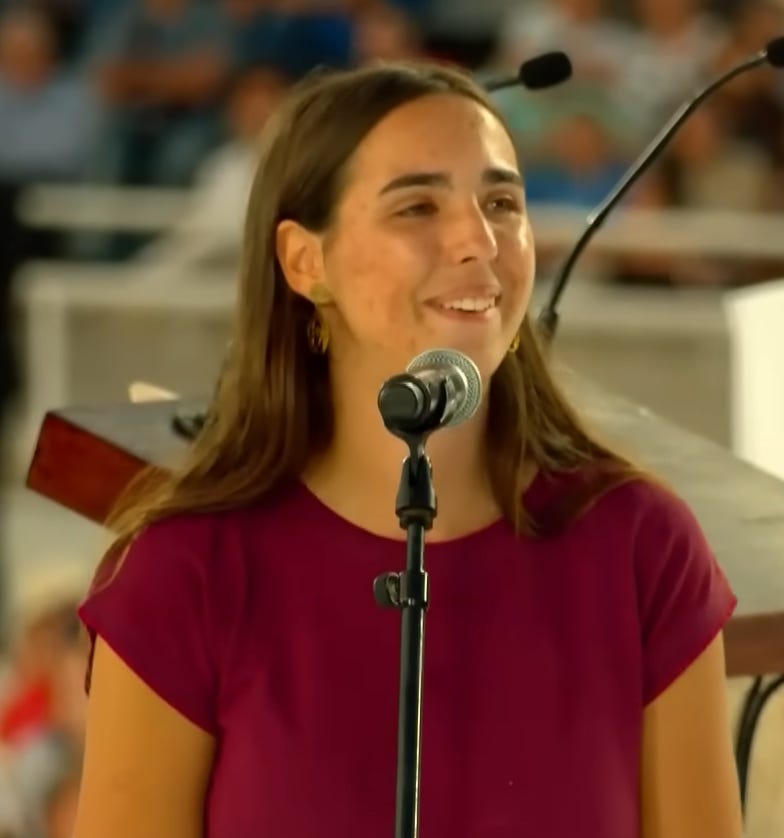
She was from a poor part of the city. When she was small, she said, her father tried to kill her mother. A stranger stepped between them. He took the blow meant for the mother, and died for it. Her father went to prison. Her mother went to drugs. At ten she went to a children’s home, where she built a wall so high that for years no one got over it.
Then, slowly, someone did. She found people who loved her. She found God. And still — she said this plainly, into the microphone, in front of everyone — she cannot forgive her father. Some nights she looks up at the sky and asks one question.
Where were you when I was a little girl?
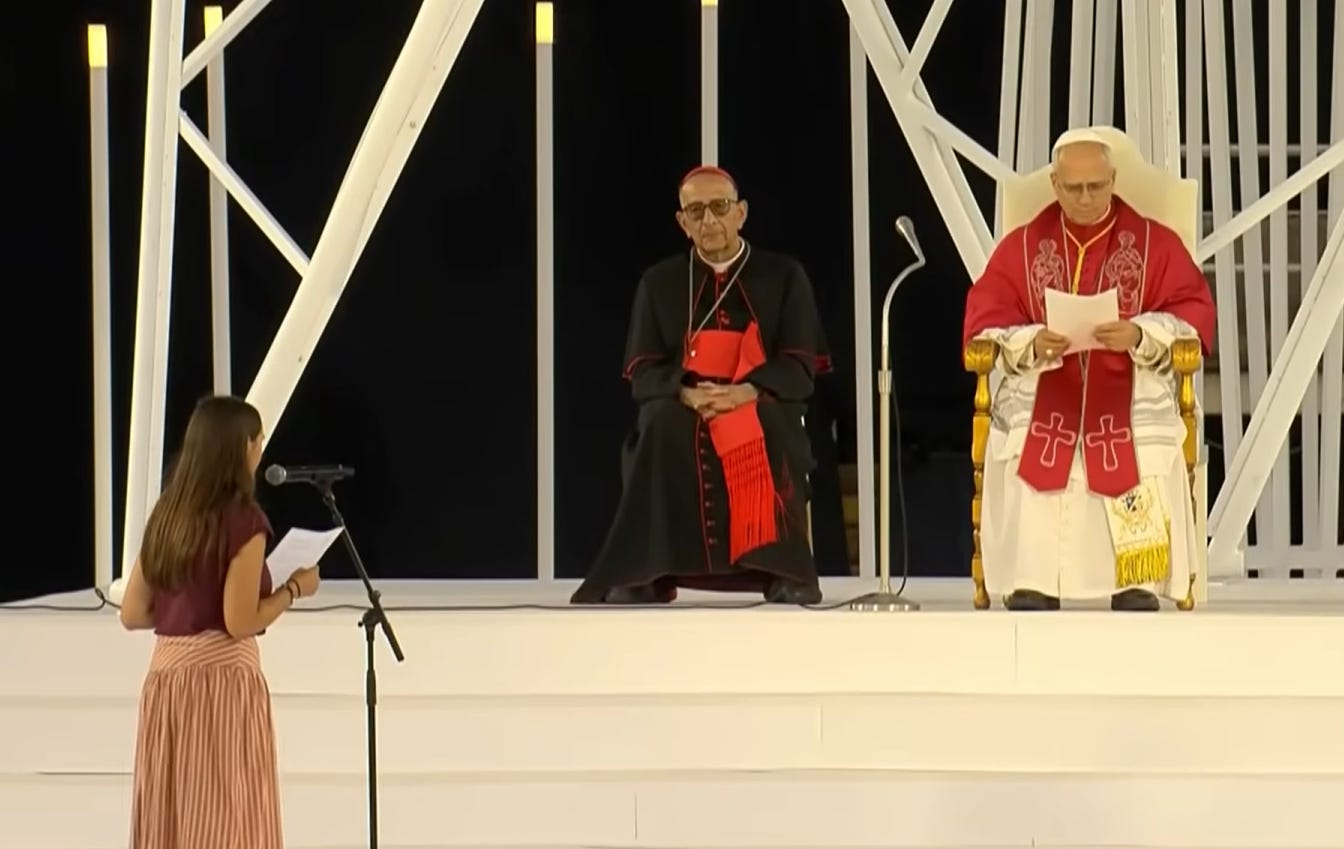
Notice who she asked.
Not her father. She did not turn toward the prison. She lifted her face to the sky. She took the deepest wound a child can carry and sent it up past the man who made it — to Someone that man was supposed to resemble.
· · ·
Today is Father’s Day, and most of us have a father to think of. The name father still has weight; we know it does, even if some choose not to admit it. What is harder to say is why.
Thomas Aquinas, who is not a sentimental man, says that after God your parents are the most important principle of your being. A father, he writes, is above his child for a single reason: he is the beginning of him.
Before you spoke a word, before you earned a grade or held a job or won an argument, someone gave you a name. Gave you bread. Gave you a face to find in the dark. You had done nothing. You could do nothing. And you were taken in anyway, and held, and called good — for no reason but that you were there.
We are tempted to picture dignity as a medal, pinned to a person’s chest from outside — by his usefulness, his record, the good opinion of the room. Aquinas thought the reverse. For him dignity is inside the word. Ask him what a person is and he gives you an old definition: a person, he says, is the kind of being whose very nature bespeaks dignity — persona est nomen dignitatis, “person” is a name for dignity. And he explains why: it is a great thing to subsist as a thing with reason, to possess a rational nature. Therefore every such being is called a person. Dignity comes from what we are. We receive a name because we are worthy of it.
A person, he says elsewhere, is the most perfect thing in all of nature — not the most useful, not the most capable; the most perfect, simply for being the kind of thing it is. The one creature that is never merely a what but always a who: master of its own acts, a little source, moving from itself instead of only being pushed about like everything else. An image, in miniature, of the One who is the source above all.
And here is what that admission costs. If dignity is built into the word person, then there is no person who has yet to earn it — and no person from whom it can be taken. It is minted with the soul, straight from God, who hands the making of a person to no one. It arrives whole, in the first instant, in a creature who can as yet do nothing at all. Sin cannot reach it; the worst a man ever did to another did not lower his victim one degree below the rank of person. Whatever else can be lost, this cannot. It subsists beneath everything done to us.
Which means the girl in Barcelona was never, for one second, worth less than the men around her — not in the children’s home, not at ten, not on the night a stranger died in her doorway. Her dignity was never her father’s to grant, and so it was never his to take away.
· · ·
So what does a good father give, if not that?
He cannot give his child a soul; that comes from God. He cannot give the child its dignity, which is there before he lifts a finger. What he can give is almost as great. He can be the first to honor it. He can look at this small, unfinished person — who can do nothing, return nothing, earn nothing — and see a someone rather than a something: not a project, not a possession, not a means to anything at all. And he can say so. With bread, and a name, and a face in the dark, until the child believes him. He gives the child back to itself. A person comes into the world complete, but it does not arrive already knowing it is a person; it wakes to that by being loved as one. The father is the first mirror in which a child sees that it is a who. That is the most precious thing one human being can hand another, because the thing it honors — personhood — is the most precious thing a creature is.
This is the whole burden of the letter the Pope has just written, the long one about the machines and the measure of a life. Strip away the policy and the warnings about AI and a single point is left: your worth is yours by virtue of existing, of having been willed and created and loved by God. Not produced. Not earned. Not useful. Willed, created, loved. The temptation of our moment, he keeps saying, is to weigh a person by output, to treat the who as a what and the end as a means. A father who is really a father refuses that with his whole life. He is the standing proof that you were wanted before you were any use to anyone. We are, every one of us, worth more than we make.
· · ·
Hold that — the source you came from, the one who honored you before you could earn it. Now look again at the girl, lifting her face to the sky. She had been handed the opposite of all of it, and still she sent her question upward, past her father, as if the real one lived in that direction. She was not wrong about the direction.
Saint Paul, on his knees, prays to the Father “from whom all fatherhood in heaven and on earth is named.” It is easy to overlook that passage. Aquinas refuses to. He says the line means something almost dizzying: that fatherhood is true of God first, and of your own father second. We have it backwards our whole lives. We think Father is a warm word we borrowed from the kitchen and lent up to heaven as a compliment. It is the other way around. The original is in heaven. Every father on earth is a copy of it — sometimes a good copy, sometimes one so smudged you can hardly read it, but always a copy of something none of us drew.
And the original looks like this: the Father gives the Son everything, the whole of himself, and loses nothing; the Son receives all of it and is no smaller for receiving. At the very summit of things, to be a person is to receive yourself entirely from another and be no less for it. That is the secret hidden under every cradle. Fatherhood is love that gives itself away and is not made poorer. A man hands his child a name, a world, all he has — and walks away richer. The strangest arithmetic there is. Also the truest.
So when the girl lifted her face from the wreckage of the copy and aimed her question at the original, she was not confused. She was aiming true. She sent the wound straight to the Father her father was always meant to point to, and failed to. And in the lifting itself she was doing more than crying out. A person’s dignity is not only a base line, it also grows. Dignity rises the nearer one draws to God in knowing and loving him. A face turned up toward heaven is a person becoming more fully herself. Her looking up was also an elevation.
· · ·
This is why the failure of a father is never a small thing. It is a sacred thing — and the size of the wound tells you the size of what was meant to be there.
But the girl, for all her grief, had a father to grieve. A copy, however ruined.
What about the one who has none of that?
The child who never knew a father at all. No face. No name. No smudged copy to hold up to the light and find wanting. Just a blank where the word should go. He cannot send his wound past the man who gave it, because there was no man. He has nothing to aim with. Does heaven have anything to say to him?
· · ·
It does. And it says his name out loud.
“A father of the fatherless is God in his holy dwelling.” That is not a tender metaphor the Psalm reaches for. It is a title God takes for himself. The one with no earthly father is not therefore without a Father; he is claimed, by name, by the only one whose fatherhood was never a copy in the first place.
And there is this. The child who never had a father still aches for one. Where did the ache come from? You cannot grieve the absence of a thing you were never owed. The hunger is the proof of the bread. That longing — for a face, a source, a someone to have come from — was not handed to him by a father, because he never had one. It was planted. It is a homing signal, and it points the only direction a homing signal ever points: home.
And his dignity, like hers, was never in any hand that could drop it. It was there in the first instant, in the very definition of what he already was — perfect and entire in a child no one came for. Sometimes the copy gets in the way: a father present and cruel, or present and cold, can stand between a child and the original for a lifetime, a smudge the child mistakes for the real thing. The one who never had a copy has, in his poverty, nothing in the way. No smudge to see past. He can come to the original with empty hands and nothing between them, and find that he was never, for one second, fatherless — and never once less than a person wholly loved. He was the Father’s from the beginning. He only had to look up to learn it.
· · ·
The Pope did not give the girl a fix. There is none. He told her forgiveness is a long road and not a switch you throw. He told her that all of us, himself first, are beggars for love. He told her to keep walking toward the light. He did not pretend her father had been a father. He turned her, gently, to face the other one — the one her father was always meant to point to, and the one who had been nearer to that little girl than she could ever have guessed.
She asked where He was when she was small.
He was being her Father. He still is.
Lift up your eyes.
This is utterly amazing. Praise God for you Father and how He uses you, thank you 🙏🏻