

There is a habit common to the whole human race. I have never met anyone free of it. We live as if we will live forever. We’re sure we’ll die, but it’s something that happens, regularly and reliably, to other people.
So we put off calling our father or mother, our brother or sister because we’re busy. We let the apology sit another week. Apologies, after all, may be like wine and get better with age. We mean to visit, to pray, to make things right. We’d do it all this very afternoon, except there’s always a tomorrow, and tomorrow has never once failed to show up. Until it does.
The servant of God, Marianna Boccolini didn’t have this habit.

She came from Narnia. Not the place you go to through a wardrobe. The real one: a hill town in Umbria, perched an hour north of Rome. The Romans called it Narnia, and the Italians, who have a gift for economy, trimmed it to Narni. C.S. Lewis came across the name in an old Latin atlas, took a liking to it, underlined it, and built a whole kingdom out of that pencil mark. The town has its own Lucy, too: Blessed Lucy of Narni, a sixteenth-century mystic who saw things other people couldn’t, a trait the place seems to have a soft spot for. Lewis’s secretary, Walter Hooper, wondered whether she gave her name to Lucy Pevensie. Lewis, true to form, never said.

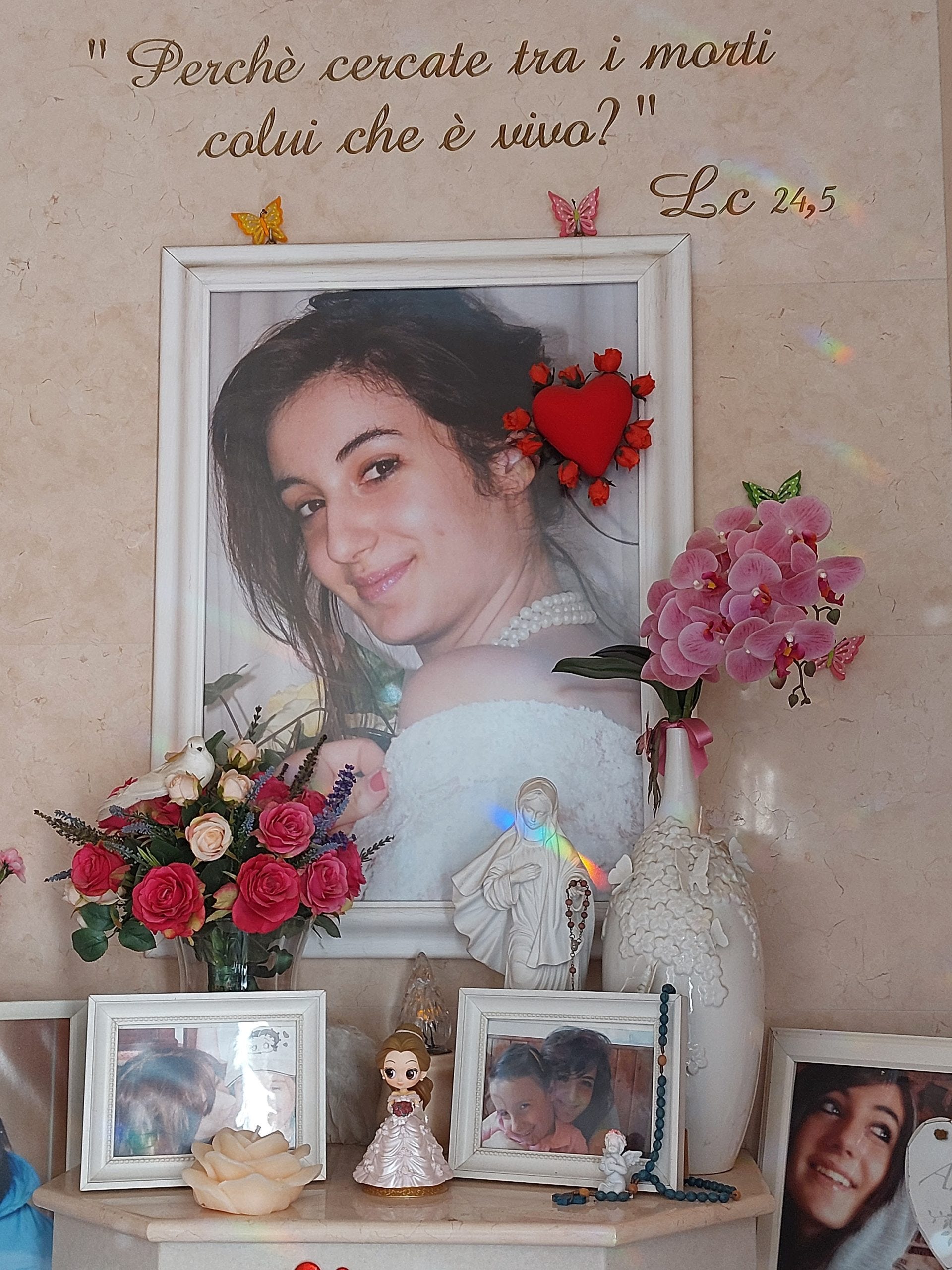
Marianna was eighteen when she died in August of 2010. A normal girl. She drew. She studied. She had a boyfriend for a while, and then she didn’t. She adored her little sister. Nothing that would make a stranger stop in the street. It’s a plain story and yet the Church has now opened her cause for sainthood. Why?
We are only at the beginning of understanding this mysterious saint. Her mother says Marianna lived every moment as if it were her last. Then she adds, the way you might correct a guest, that she didn’t mean it the way Horace did. Marianna didn’t try to live the moment in order to seize it, but to give it away.
That little distinction is worth more than it looks. It may provide us with a glimpse into the secret life of Marianna. Regardless it may provide the key to learning how to stop trying to live as if we have forever.
The poet’s advice
Everyone knows carpe diem. It is on coffee mugs and gym walls. It has been tattooed on many a forearm. The film Dead Poets Society immortalised it. Once you hear Robin Williams utter it you can hardly avoid hearing it in any other voice.
It comes from a small poem Horace wrote to a woman named Leuconoë, who had been visiting fortune-tellers to learn how many years she had left. Horace, kindly, tells her to stop asking. The gods will not allow one to know. Strain the wine, he says, by which he means, “get the wine ready to drink.” Cut your long hopes short. And then the line that outlived the Empire:
Carpe diem, quam minimum credula postero.
Seize the day. Trust tomorrow as little as you can.
Carpe is an odd word in Latin. It comes from the orchard. You pluck, carpe, the fig when it is ripe, because if you don’t, tomorrow the wasps come. Anyone who has done a bit of gardening knows that this is not easy. It requires watchfulness, knowing the right moment, one must be attentive.
There is something lovely here, and something honest. Horace is not a brute. He is a tired, civilized man who has looked at death squarely and decided not to be afraid of it. Many of us could use a little of his composure.
But follow the thought to its end. If the day is a fig, then I am the one who eats it. In Horace, death sends us back into ourselves: the clock is running, so take what you can while you can. It is the wisdom of a world without a tomorrow. It is not nothing. It is only not enough.
The girl’s question
Marianna had a habit. Her mother called it her theory of the last day.
Before she saw someone, before she wrote a note or wrapped a present, she would put a plain question to herself: what if this were the last time?
Not the last time I can enjoy this. The last time I can give it.
It is Horace’s thought, turned around. The nearness of death did not make her moment smaller or more private. It made the moment larger, and it made the other person enormous. The friend across the table was no longer someone to get through on the way to something else. She might be the last face Marianna would ever be kind to.
Her mother says this gave everything her daughter did a color from another world. One can believe that. Attention can do strange things. It is the rarest form of love and the hardest to counterfeit. Everyone knows at once when someone is paying attention to them. A girl wraps a gift as though she will never wrap another. Is that morbid? Or is that accurate?
Her favorite prayer was the one we attribute to St Francis: make me an instrument of your peace; let me seek to console rather than to be consoled. That was her little theory. A prayer could shape action.

The poet says: you will die, so eat, drink, and enjoy. In short, take as much as you can. The girl says: you will die, so feed as many as you can. Give and give now.
She was not given long to do it.
It was the middle of August, the week of Ferragosto, when Italian towns empty out for the holidays and young people stay up late because there is nowhere to be in the morning. Marianna had spent the evening with friends. Sometime around two o’clock, four of them got into a car to drive home to Narni.
They never made it. About three kilometres from home, near the village of Stifone, the car skidded on the Ortana road. It struck the guardrail, then a concrete pillar, and then it caught fire. Marianna died instantly. So did one of her friends. A third friend reached the hospital alive, but died soon after. The boy at the wheel was the only one who lived.
If that were the whole story, it would be one more tragedy of the kind every small town knows: a late night, a bend in the road, the phone call no parent ever wants to get. But the twist in the story happened just before the crash, and just after it.
That summer, Marianna had told her mother more than once that she sensed her life was coming to an end. It is hard to know what a mother does with words like that. The mother tried to brush it aside, saying, “if you were to die, perhaps I would just go with you.” Marianna became serious, “no, mamma, you must live. After all, we'll be together again forever.”
There was something else. The boy who would be driving that night had lost his own mother just seven months before. Marianna had stayed close to him through his grief; she knew what he was carrying. One day her mother said something critical about him, and Marianna stopped her. She raised one finger, looked her mother in the eye with a calm firmness, and told her, “Mamma, no matter what happens, you must never judge him.”
At the time it must have sounded like ordinary teenage loyalty. A few days later, it sounded like something else.
Put yourself in that mother’s place for a moment. Your daughter is dead. The young man who was driving is alive. Everything in you wants someone to blame, and there he is.
He asked whether he might come to the funeral, in the cathedral of Narni where Marianna had been confirmed four years earlier. He came. And Marianna’s mother did not turn him away. Afterward she took him aside, privately, and thanked him. In those first terrible minutes after the crash, before the flames took hold, he had pulled her daughter’s body out of the car.
Read that again. A mother, at her daughter’s funeral, thanking the driver.
You do not do that on your own strength. Most of us could not. Her mother says it plainly: the only explanation is the grace of forgiveness, and Marianna had already prepared her for it. This is what the last-day theory looks like when someone else has to live it. In her final days, Marianna had been teaching her mother how to give the hardest gift there is, forgiveness, while the wound is still open.
The story did not end on the Ortana road
For most families, a car crash at eighteen is the last chapter. A grave, a photograph on the mantel, a bedroom no one can bring themselves to empty. For a while, that is what Marianna’s story looked like.
Then something began to happen that no one planned.
Marianna came from a Catholic family that, by its own account, did not practice much. Her mother says it was her daughter who brought her back to the faith, and not only her. People began to find their way to the little chapel in the Narni cemetery where Marianna lies, dressed as a bride. They left flowers and notes. They asked for her prayers. Some say they have received graces, even miracles. The Church has not yet judged those claims. But the visitors keep coming.
Her words began to travel, too. From the age of nine she had kept a diary, and she wrote poems, short stories, and reflections far beyond her years. One of her teachers recovered some of those pages, and they were published in her memory. Now there are biographies in Italian and in French, a collected edition of her writings, and a foundation in her name that carries on her dream of “a world in color.” Her mother says she is still astonished by it all. Marianna, it turns out, does not belong only to her.
And in June 2025, fifteen years after the crash, the Bishop of Terni-Narni-Amelia formally opened the diocesan inquiry into her cause for beatification. The girl from Narni is now a Servant of God.
This is the part Horace could never have written. In his world, death closes the account: whatever you plucked from the day is all you will ever have. But Marianna’s days were not consumed. They were given away, and what is given to God is not lost. It is planted. Unless a grain of wheat falls into the ground and dies, Jesus said, it remains alone; but if it dies, it bears much fruit (Jn 12:24). Her short life is bearing fruit now, in the lives of people she never met.

What the Bible already knew
Here is a curious thing: Scripture has met Horace before.
In the Book of Wisdom, written in Greek in Alexandria, the ungodly sit together and reason that life is short and ends in smoke. So, they say, “let us crown ourselves with roses, before they be withered” (Wis 2:8). It is carpe diem with a Jewish author’s verdict written underneath it.
St Paul goes further, and is more generous. If the dead are not raised, he says, then by all means: “let us eat and drink, for to morrow we shall die” (1 Cor 15:32). He is not mocking the poets. He is conceding that they are right, if Easter did not happen. Everything hangs there.
But the Bible keeps its own remembrance of death, and it runs the other way.
The psalmist asks God to teach us to number our days, so that we may gain a wise heart (Ps 90:12). Counting the days is meant to make us wise in them, not greedy for them. Ben Sira says that if we remember our last end in all we do, we will not sin (Sir 7:36). And Jesus tells of a rich man who plans, at last, to relax, eat, drink, and be merry, and who is told that his soul will be required of him that night (Lk 12:19–20). He did exactly what the poet advised. His mistake was not that he enjoyed the present. It was that he enjoyed it alone.
Then comes the line that explains Marianna entirely: whatever you did for the least of these, you did for me (Mt 25:40). If that is true, then no encounter is small. Any one of them could be the last chance to love Christ in a particular face.
The monks made this a discipline. St Athanasius tells us that St Antony urged his brothers to live each day as though it would be their last, and so keep themselves from sin. And those of us who live under the Rule of St Benedict hear one of his tools of good works read aloud several times a year: mortem cotidie ante oculos suspectam habere. Keep death daily before your eyes (RB 4.47).
Not to darken the day. To see it.
How to stop living like you have forever
Here is the honest truth about most of us. We do not seize the day like Horace, and we do not give it away like Marianna. We postpone it. The apology can wait. The call to our father can wait. The visit, the confession, the prayer we keep meaning to start: all of it can wait, because there will always be time.
Marianna’s story says otherwise. And it offers a way out, not a technique so much as a few habits anyone can begin this week.
Ask her question. Before the next conversation, the next meeting, the next phone call home, ask yourself: if this were the last time, how would I love this person? You will be surprised how much changes.
Do not postpone the good word. If there is something you need to say, thank you or I’m sorry or I love you, say it today. “Let not the sun go down upon your anger” (Eph 4:26) is not only a rule about arguments. It is a rule about time.
Forgive before you are asked. Marianna told her mother not to judge before there was anything to forgive. Decide now, in advance, that you will not hold the grudge. When the moment comes, you will be glad it was settled early.
Keep death before your eyes. Not to darken the day, but to see it. Each night before you sleep, ask two questions: whom did I love well today, and whom did I pass by? It takes two minutes, and it is one way to keep St Benedict’s counsel.
The poet and the girl both looked at death and said: pay attention to today. One closed his hand around the fig. The other opened hers. The difference was hope. Marianna could be reckless with her attention because she believed none of it would be wasted. Sixteen years on, it turns out she was right.
The Letter to the Hebrews speaks of the great cloud of witnesses around us (Heb 12:1). She belongs to it now, I think, and she is still asking the question she asked herself every day:
If this were the last time, how would I love?
One day it will be the last time, for each of us and for everyone we love. Do not live as though you have forever. Live as though you have today, and give it away.
Sources
Cecilia Galatolo, Marianna Boccolini: Il Sorriso della Compassione (Gorle: Velar, 2022).
Horace, Odes 1.11; Rule of St Benedict 4.47; Athanasius, Life of Antony 19. Scripture quotations from the Douay-Rheims.
"Not to darken the day. To see it." Carpe Diem is the flip side of Memento Mori- remember your death so that you may fully see the gift of today. Thank you for sharing this story!!
Grazie 🕊️