

Some time ago, someone asked me—almost apologetically—whether binaural beats were “okay to listen to.”
He had found them the way most people do now: through an algorithm that seems to know our fatigue before we do. He wasn’t chasing a new spiritual technique. He was trying to sleep. He struggled with tinnitus, and he told me that a certain frequency, played through headphones at night, seemed to loosen his jaw and quiet the ache enough for rest to return.
I understood the desire immediately. Modern life produces a constant interior noise. The nervous system stays braced. The mind runs its loops. Silence becomes a luxury good. And so we reach for whatever can steady us.
But the question stayed with me—not because binaural beats are a special problem, but because they reveal a larger one. More and more we are learning to manage the interior life by techniques, and we are looking for guides—voices, methods, “creators”—who can tell us how.
Everyone has mentors now, and yet few people are truly mentored.
We are living through an odd reversal. In earlier ages a young person’s world was smaller but thick with apprenticeship. A trade had a master. A household had elders. A parish had a priest who knew your name. You were formed, for better and for worse, by people who could not be replaced with a click.
Now our world is vast. We have access to a thousand voices at once. We can hear the best speakers and read the best writers, often for free. And yet something essential is missing: the kind of guidance that does not merely inform but forms.
In a word, we have influencers where we need mentors.
The Modern Telemachus
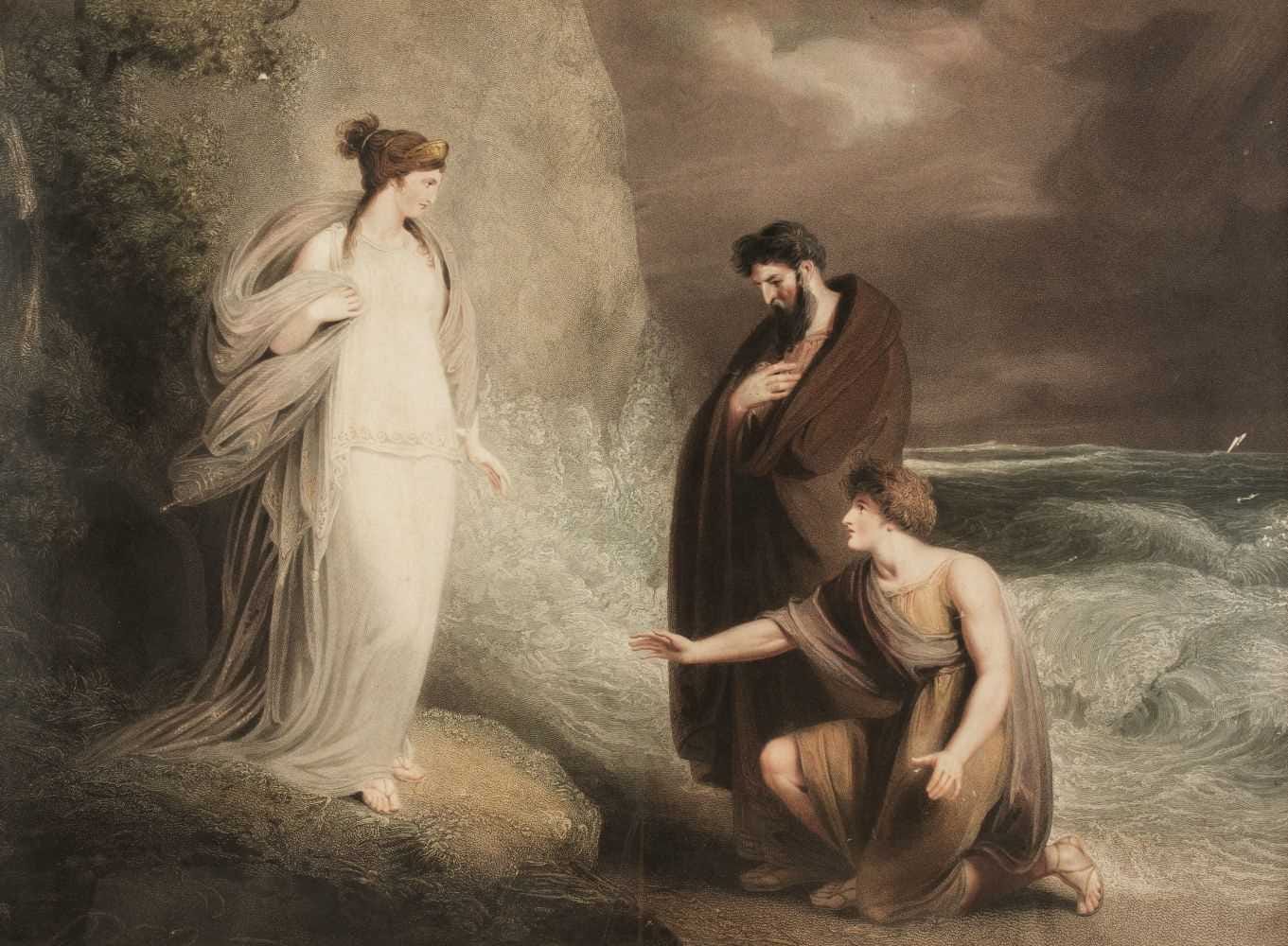
In Homer’s Odyssey, Telemachus is the young man left alone in a house that no longer feels like his own. His father is absent. His mother is surrounded by voices that demand attention. His home is filled with noise, appetite, and disorder. And Telemachus is caught in a particular kind of paralysis: he knows something is wrong, but he does not know how to act.
He is not stupid. He is not indifferent. He is not without a conscience. He is simply not yet steady in his footing—not yet permitted to act with authority, not yet supported by the kind of strength that lets a young man step forward without collapsing into either rashness or retreat.
The Odyssey's continued return in our cultural imagination is a testament to the enduring fascination of this figure. Even now, new retellings and adaptations appear in quick succession because we instinctively recognize ourselves in the story: the son searching for a form of life, a home, a father, a way to stand.
One of the most recognizable figures in Western literature is the son without a father Hamlet cannot act because the father’s absence becomes a kind of interior fog: he is haunted by a command, yet uncertain how to embody it. Stephen Dedalus, the hero of Joyce’s Ulysses, and a stand-in for Telemachus, is brilliant and perceptive, but homeless in spirit, unable to find a form of life sturdy enough to live inside. Ignatius Reilly, in John Kennedy Toole’s A Confederacy of Dunces, is a more comic and painful heir: a man who carries a pre-modern imagination into a world that no longer knows what to do with it, and so his gifts become misfitted and grotesque. And in The Brothers Karamazov, the father is not absent but catastrophically present—so corrupt and contemptible that the sons’ lives are shaped, each in his own way, by the struggle to escape his gravitational pull.
Different stories, different tones, but the same modern wound: when fatherhood fails—by absence, by weakness, by corruption, or by sheer incoherence—the soul is left searching not only for guidance, but for the confidence and support that make action possible.
Then, in Homer, a figure appears: Mentor—Athena in disguise. For many readers Athena is a distant name from mythology, but Homer intends something very human by her presence. She represents wisdom and clear-sightedness, yes, but also courage, strength, and a kind of compassion for our frailty. She does not shame Telemachus for hesitating. She steadies him. And she does not replace his father; she awakens him to seek him. Mentor does not simply deliver information. He gives heart. He strengthens the will. He sets the young man in motion.
This is more than a plot device. It is an image of what the Greeks called paideia—that slow formation of the person through the wisdom of a people, the transmission of a culture’s sense of what is noble, what is fitting, what is excellent. Werner Jaeger used that word to describe how a civilization hands on not only skills, but arete: excellence of soul, the capacity to judge rightly, to act well, and to become the kind of person whose freedom is not mere impulse but a trained and truthful strength.
The modern Telemachus still exists. In fact he is everywhere. He is the student who has read too much and committed too little. He is the young adult who has thirty open tabs of advice and no peace. He is the person who wants to do the good but cannot determine what the good looks like amid a flood of competing voices. He is the one who senses the disorder of the house but does not know how to restore it.
And he is vulnerable—precisely because he wants guidance.
Because where genuine mentorship thins out, substitutes rush in.
Influencers as Substitutes for Mentors
Not every influencer is shallow, and not every online voice is manipulative. Some people speak with real integrity. Many do genuine good. And it would be unfair to pretend that the impulse behind much of “influencing” is always cynical. Modern influencers often do want to spur people to act—to get out of passivity, to make changes, to take responsibility. In that sense, they can resemble the ancient figure of Mentor: the voice that comes alongside the hesitant and says, “Move. Begin. Do not stay stuck.”
The difficulty is not usually a malicious intention. It is the structure in which that intention is carried. The platform itself shapes what rises to the top. The attention economy rewards certain patterns that are not necessarily opposed to mentorship, but are easily mistaken for it.
A true mentor can be decisive, but his decisiveness is tethered to your concrete life. He can be confident, but his confidence is tempered by humility and by the knowledge that he does not see everything. He can urge action, but he urges action ordered to the good—action that makes you more truthful, more stable, more free.
This is where the crucial difference emerges.
A mentor’s aim is to help you become free—free to judge, free to choose, free to stand on your own feet before God. An influencer’s livelihood, even at its most benign, is often bound to keeping you engaged: returning for the next installment, the next insight, the next “framework,” the next product, the next course, the next community.
Even when the advice is sound, the relationship is not the same. It is not a covenant. It is not apprenticeship. It can inspire, and it can inform, but it rarely forms—because formation requires time, particularity, and a kind of accountability that cannot be scaled.
This is why a person can spend years consuming “self-improvement” content and remain strangely unchanged. They know more. They have more categories and vocabulary. They may even feel periodically motivated. But they are not necessarily better—more patient, more truthful, more courageous, more charitable.
And this is also why people who struggle with anxiety or scrupulosity are especially vulnerable to the endless cycle of guidance. If you fear making a mistake, you naturally seek a voice that will guarantee safety. But safety never arrives, because the internet cannot do what a mentor does: it cannot discern with you, in your concrete circumstances, over time. It cannot carry the weight of your life in a personal way.
Instead it offers more choices.
More voices. More techniques. More “answers.”
And so Telemachus sits in the house again, surrounded by suitors—not suitors for his mother’s hand, but suitors for his attention.
What Is Prayer, Really?
This brings me back to that question about binaural beats.
It was a small example of something larger: the way we now tend to self-diagnose our inner life, and then reach instinctively for whatever the algorithm places in front of us as the remedy. We are tired, anxious, restless, distracted, in pain—and within minutes we are being offered a solution: a frequency, a breathing protocol, a supplement, a “morning routine,” a therapist on a screen, a creator with the right confidence, a community with the right vocabulary.
Some of these things can help. We are embodied, and it is good to receive ordinary means of relief. A racing mind often settles if the body is allowed to settle. There is nothing unspiritual about sleep, silence, and a calmer nervous system.
But the deeper question is what happens when formation is replaced by a set of problems to optimize, and guidance becomes a stream of techniques.
This is where the Christian tradition speaks with a different accent. It does not begin by asking how to produce a state, but how to become a person.
Saint Francis de Sales—whose feast we celebrate today in January—puts it with his characteristic gentleness: the first act of prayer is not to speak, and not even to feel, but to notice. We do not force ourselves into God’s presence because we never leave it. We simply become aware of what is already true.
That single shift changes everything. It means that the most important movements of the soul cannot be outsourced to a feed. They require presence: real attention, real relationships, real accountability, and—above all—the presence of God.
And so what we call an “influencer problem” is ultimately an anthropology problem. How is a human person formed? How do we become capable of truth, freedom, and love?
The Christian tradition has an answer—and it is older, and sturdier, than the attention economy.
A Christian Account of Mentorship
Christianity is not a project of self-invention. It is a school of discipleship. We do not manufacture ourselves. We receive a form of life.
This is why, from the beginning, Christian formation has always had mediations: Scripture, sacraments, the liturgy, the rhythm of fasting and feasting, the discipline of confession, the companionship of saints, and the guidance of wise people who help us interpret our lives under God.
In other words, Christian mentorship is never merely “life advice.” It belongs to a larger ecology: the Church.
A good spiritual guide does something very simple and very rare: he helps you see your life truthfully in the presence of God, and he helps you act with freedom.
He is not a substitute conscience. He is not a personal oracle. He is not there to remove all risk.
He helps you become the kind of person who can respond to grace.
And that last phrase matters. Because to be mentored is not to be controlled. It is to be awakened.
This is why the best mentors have a particular quality: they do not want you to need them forever. They want you to grow up in Christ.
A Thomist Deepening Without the Jargon
If you ask how a Thomist might approach this, you can say it without technical terms.
Aquinas believes that human beings are formed not only by what we know, but by what we love and repeatedly do. Character is shaped through habits. Virtue is not a mood. It is a stable capacity for the good.
And that means: you cannot become wise by consumption alone.
You cannot download prudence.
Prudence—the ability to see what is good here and now, and to choose it—comes through time, experience, correction, prayer, and the slow purification of desire. It comes through living.
A mentor, in this view, is not primarily an “expert.” He is someone who helps you acquire a form of life. He helps you learn how to judge, not just what to think.
But Aquinas adds something even more important: the Christian life has a true model, an actual pattern, not invented by us. If you want to become a Christian, you must become like Christ.
That seems obvious, but it has serious implications.
It means that every human mentor is secondary. He is not the standard. He is a witness.
He is useful insofar as he helps you conform to Christ.
And that brings us to the heart of the matter. Because there is one exemplar who cannot be replaced by an algorithm, one mentor who cannot be scaled, branded, or monetized.
Christ and the True Form of Mentorship
Christ is not an influencer.
He does not compete for attention. He calls for conversion.
He does not curate an image. He gives his life.
He does not promise a shortcut. He offers a cross—and then, something unimaginably more: participation in his own life.
In the season of Epiphany, the Church places before us a particular kind of light. The light of Christ does not arrive as a spectacle. It arrives as a child in a crib, as a voice at the shoreline, as a call to fishermen: “Follow me.”
This is the reversal the Gospel never stops making.
We look for power, and God gives humility.
We look for certainty, and God gives enough light to take the next step.
We look for mentors who will guarantee outcomes, and God gives a Person who asks for trust.
The wisest men of the ancient world—the Magi—do not receive a lecture. They receive a manifestation. They kneel. They adore. And then they go home by another way.
This is what Christ does: he does not merely teach us what to do; he changes what we are.
And that is why his exemplarity is not moralism. It is not “try harder.” It is a form of life communicated by grace.
The saints mentor us precisely because they are transparent to this. They do not draw us toward themselves. They make Christ more believable.
And the best mentors in our own lives do the same. They may be quiet. They may have no platform. They may never be “known.” But they have a certain unmistakable quality: they make you more free, more truthful, more peaceful, and more ready to love.
They help you leave the nets.
A Small Practical Conclusion
So what do we do in an age of influencers?
We do not need to reject the internet. We need to re-order it.
We can receive online voices as a supplement, but we should not give them the role of a mentor. Prefer presence over persona, accountability over charisma, patience over novelty. Look for guides who decrease your dependence rather than increase it.
And most of all, do not forget that the first Mentor is already present.
God is not far away, and the light is not inaccessible. It may seem small—like a child in a crib, like a star in the night, like a quiet nudge of conscience aided by grace—but it is enough.
If you are looking for concrete next steps, here are a few.
First, if you are reading this on Substack, consider staying. Substack is becoming a surprisingly good place to grow a real community: not an audience, but a circle of people returning week after week to the same questions, learning to see more clearly together.
Second—and this is the most important—enroll locally. Commit to a parish. Learn names. Serve somewhere specific. Receive the sacraments faithfully. Offer your own wisdom to the people God has actually placed around you. The internet can widen your horizons, but only local life can form you.
Finally, one practical project I am working on with others is the Byway app, currently in alpha testing. We are trying—carefully—to explore what it would mean to build a tool that supports the kind of steady, personal formation usually associated with spiritual direction: not another feed, but a path; not content to consume, but a structure that helps you return, day after day, to prayer, Scripture, and small habits of Christian life. If you try it and notice what helps—or what gets in the way—please tell me. At this stage, your feedback matters. The goal is not to capture attention, but to learn how to support consistency without turning formation into consumption.
And if what you need right now is not spiritual direction, but practical help in putting your life in order—habits, priorities, decision-making, and a workable plan—I can also recommend Clarity Life Consulting, a Catholic therapist’s practice focused on life planning rather than spiritual direction.
In the end, the Christian does not graduate into autonomy. He graduates into communion—not with an audience, but with Christ.
And it is there, in that communion, that all mentoring finds its measure and its end.
Father Joseph, what is your doctorate degree in?
I am very grateful for your meditation here, Father. I am 59 and have sadly spent the better part of my life not quite fitting in, often sinning horribly in response to my own anxieties and insecurities, and wearing out and through many mentors and friends and even family.
When I set out to read Confederacy of Dunces years ago, I just barely made it to the third chapter. I saw myself ridiculously reflected back in the form of the protagonist.
These 15 or so years later my life has been pruned to its core. After years of necessary subtraction and loss and pain, I have finally found my way to the One, Holy, Catholic and Apostolic Church, by the previenient grace of God in Christ and by His Holy and Blessed Mother.
Your piece here both reminded me of how far I have come by grace, and how far I have yet to go. I only ask that you might pray for me. I write and post under a pseudonym mostly so as to not cause scandal, but also to protect my own privacy. I trust God will know for whom you pray.
Thank you again.