

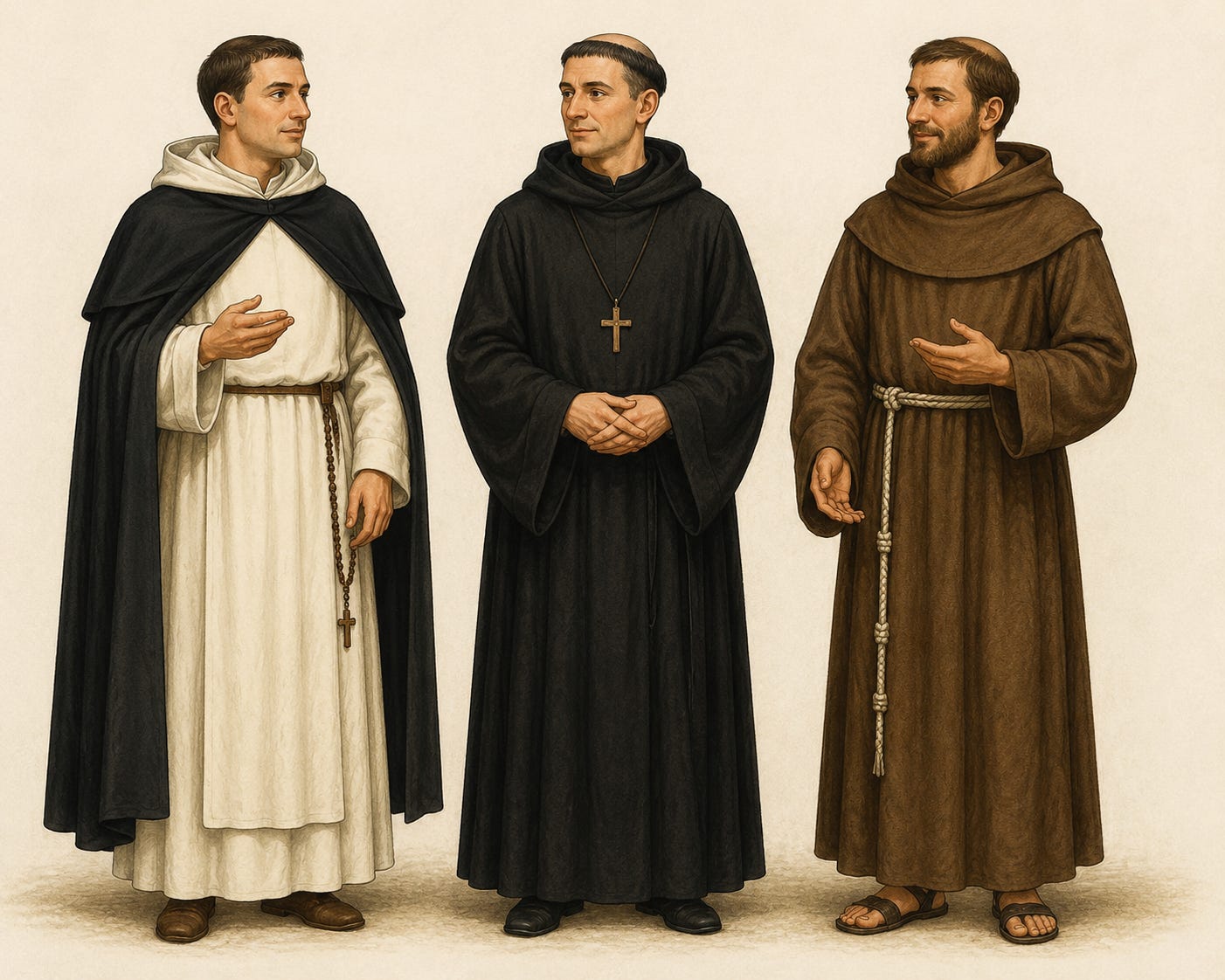
People often ask me: what is the difference between a monk and a friar?
A first answer might be: monks stay in the monastery, friars go out into the world.
That is not entirely wrong, but it is too simple. In fact, it quickly breaks down.
St Boniface was a monk and a missionary. St Bernard was a monk and one of the great public voices of the twelfth century. St Hildegard was a Benedictine abbess, but her letters, visions, music, and teaching reached far beyond the enclosure of her monastery. Many monks have preached, taught, evangelized, advised popes and princes, founded monasteries, reformed the Church, and travelled far from home.
So the distinction cannot be: monks are contemplative and friars are active. Nor can it be: monks stay inside and friars go outside.
The better distinction is one of spiritual center of gravity.
A monk is rooted in a monastery. He belongs to a particular house, under a rule and an abbot, in a life ordered by prayer, stability, obedience, conversion of life, work, silence, and the praise of God. Even when he is sent out, he remains a man of that place. He is not simply an individual religious professional. He is a son of a monastery.
A friar belongs to a different form of religious life. The great mendicant orders — Dominicans, Franciscans, Carmelites, Augustinians — were shaped more directly for mobile apostolic work. They are brothers sent among the people for preaching, teaching, confession, poverty, evangelization, and service.
So the simple formula is this:
The monk is rooted in the monastery, even when sent out.
The friar is formed for mobile apostolic service.
This distinction is already visible in St Benedict’s own way of thinking. In the Rule, Benedict famously describes four kinds of monks. The cenobites live in community under a rule and an abbot. The anchorites are hermits, but only after long formation in community. These two forms are approved.
But Benedict also criticizes the sarabaites, who live without real rule or obedience, and the gyrovagues, the wandering monks who drift from place to place. His concern is not merely geography. It is spiritual instability. The problem is not movement as such. The problem is movement without obedience, without conversion, without roots.
That helps explain why a monk can be sent away from his monastery and still remain fully monastic. The question is not simply, “Where is he physically located?” The deeper question is, “From where is he sent, and to what does he remain bound?”
A monk sent to Rome for study is still a monk. His study is not a private academic adventure. It is part of his obedience. It is a work received from the monastery and ordered, ultimately, back to God and to the service of the Church.
This is important because study itself can be monastic. For a monk, study is not merely career preparation or intellectual achievement. At its best, it belongs to the search for God. It is connected to lectio divina, Scripture, the Fathers, theology, liturgy, wisdom, and prayer. A monk studies because truth matters, because contemplation requires purification of the mind, and because the Church needs men formed by silence as well as by books.
A Dominican friar also studies, of course. St Albert the Great and St Thomas Aquinas are obvious examples. But in the Dominican tradition, study is structurally ordered toward preaching: to contemplate and to hand on to others the fruits of contemplation. That is a beautiful and necessary vocation.
The monastic emphasis is different. The monk studies from stability. His study deepens the life of prayer, strengthens the monastery, and serves the Church from within a life fundamentally ordered to seeking God.
There are also forms of religious life that stand between these poles. Canon regulars, for example, combine common life, the Divine Office, rule, discipline, and a quasi-monastic rhythm with priestly ministry, pastoral care, and sacramental service. They are neither simply monks nor simply friars. They show how rich and varied the Western tradition became.
Then there is the Ignatian innovation. The Jesuit is not a monk, and not simply a friar either. St Ignatius shaped a form of religious life centered on discernment and mission. The question is not first, “How do I remain in the monastery?” Nor simply, “How do I preach among the people?” It is, “Where is God sending me now?”
Put very simply:
The monk asks: How do I remain with God?
The friar asks: How do I bring God to others?
The Jesuit asks: Where is God sending me?
Of course, these formulas are too neat. Monks also bring God to others. Friars must remain with God. Jesuits must pray, study, obey, and live religious life. But the formulas help us see the different spiritual architectures.
The monk is not less monastic because he is sent out. St Boniface did not stop being a monk when he became a missionary. St Bernard did not stop being a monk when he preached reform. St Hildegard did not stop being a Benedictine abbess when she taught the wider Church. Their outward work flowed from an inward root.
That is the key.
The monk’s mission flows from stability.
This is why being sent away from the monastery can still be deeply monastic. The point is not that the monk never leaves. The point is that he leaves as one who belongs. His fruitfulness depends on remaining inwardly attached to the place, rule, community, obedience, and prayer from which he has been sent.
The friar is formed for mobility.
The monk may be sent from stability.
Those are not contradictions. They are two different gifts in the life of the Church.
Thank you. Are standards looser now than in medieval times, I wonder. After all, some Friars host shows on television and Internet. But I am glad they do: it was seeing startling Father Benedict Groeschel on EWTN that made me pause and look closer at this channel. Much to my surprise, it was the Catholic faith.