

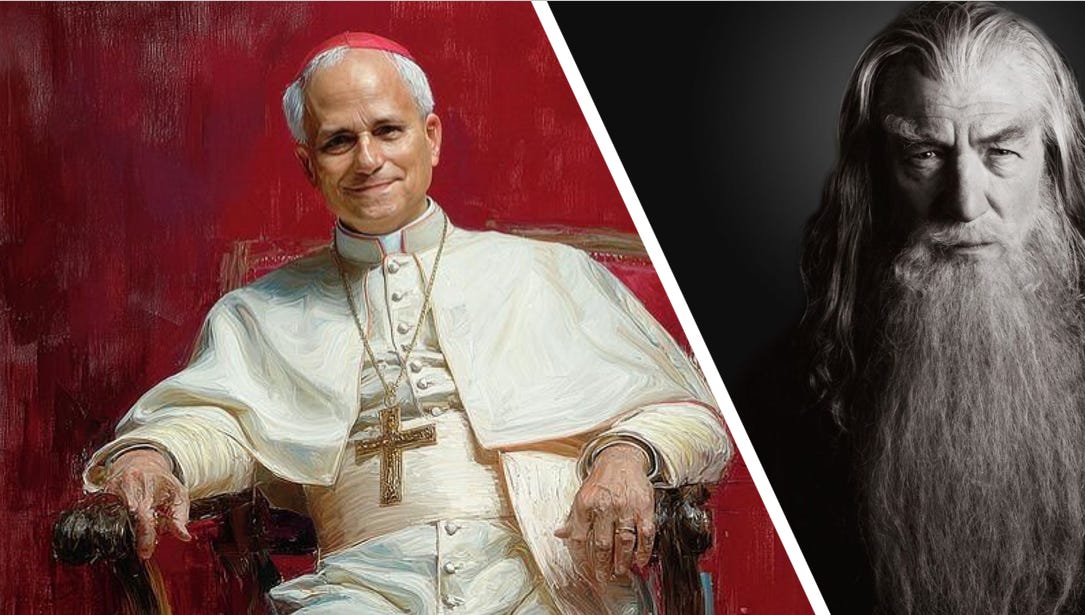
On 25 May 2026, the Catholic Church published its most important social document in a generation. Magnifica Humanitas — Pope Leo XIV’s encyclical on artificial intelligence — runs to 245 paragraphs and cites Augustine, Aquinas, Arendt, Frankl, Plato, and even Gandalf.
The passage comes near the end of the document, in a section on shared moral responsibility in the age of AI. Leo XIV cites J.R.R. Tolkien — describing him as “the twentieth-century Catholic author” — and quotes The Return of the King: “It is not our part to master all the tides of the world, but to do what is in us for the succour of those years wherein we are set, uprooting the evil in the fields that we know, so that those who live after may have clean earth to till.”
The words are Gandalf’s. A fictional wizard. In a papal encyclical. Alongside the Doctor of the Church and a survivor of Auschwitz.
I have been thinking about why this doesn’t feel strange — why it feels, in fact, exactly right.
The dominant imagination of our technological moment was written by Francis Bacon in 1627. His unfinished utopia, The New Atlantis, describes a perfect civilization organized around Solomon’s House: an institution dedicated to mastering nature for the relief of human suffering. Knowledge is power. Power is salvation. The goal is to push the boundaries of what is possible as far as they will go. Scale, speed, and capability are the measures of progress.
That dream runs in a direct line from Bacon’s unfinished island to the campuses of Silicon Valley. You can hear it in the language of AI development: building general intelligence, solving alignment, accelerating toward a future that exceeds anything we can currently imagine. The ambition is civilizational. The stakes are, explicitly, the fate of humanity. The builders see themselves as the protagonists of a story that large.
Tolkien spent his life writing a counter-argument to that imagination. Middle-earth is not a world you can master. The One Ring — the supreme instrument of power and knowledge — corrupts everyone who tries to use it for good, even Gandalf, even Galadriel. The only solution is to destroy it. Frodo does not save the world through capability or ambition. He saves it through endurance, humility, and the willingness to carry a burden one small step at a time, in the particular place where he happens to have been set.
When Leo XIV reaches for Tolkien rather than Bacon, he is choosing a story. He is saying: the Church’s imagination of what technology is for, and what human beings are for, runs through the Shire, not through Solomon’s House.
I want to say something to those who approach this document with suspicion — whether of the magisterium generally, or of this pope specifically, or of any institution that dares to speak about technology when it doesn’t write the code.
The encyclical knows it is entering contested territory. It is not naive about this. What it offers is not a technical manual but a tradition — 135 years of thinking about what happens to human dignity when power concentrates and the person becomes a means rather than an end. That tradition began with Leo XIII looking at factories in 1891 and asking who they served. It continues here with Leo XIV looking at algorithms in 2026 and asking the same question.
You do not have to agree with every passage to receive that tradition. Several serious Catholic thinkers have already raised questions about specific arguments, particularly on just war. Those debates are worth having. But they are not reasons to close the document before reading it. A tradition that cannot be questioned is not a tradition; it is a slogan. What makes this document worth engaging is precisely that it is serious enough to generate serious disagreement.
Here is how I would suggest approaching it.
Start with the Introduction and Chapter Three. The Introduction gives you the two biblical images — Babel and Nehemiah — that organize everything else. Chapter Three gives you the encyclical’s deepest argument: what the technocratic paradigm is, what AI threatens to do to our sense of what a human being is for, and what cannot be lost. If those chapters move you, read the rest. If they don’t, the guide in the comments will give you what you need.
Resist the urge to receive it as a position paper on AI policy. It is not primarily that. It is a document about what kind of civilization we want to build and what kind of people we want to be while building it. Those are questions that belong to all of us — not only to technologists, not only to Catholics, not only to those who already agree.
The wizard said it plainly. Do what is in us. Uproot the evil in the fields we know. Leave clean earth to till.
That is not a small ambition. In the age of AI, it may be the right-sized one.
I have included a Catholic Family Guide to Magnifica Humanitas — including a chapter-by-chapter overview, the scholars behind the document, and conversation starters for families — in the comments below.
I've put together two free resources to help families, parishes, and communities engage with it.
📄 A fourteen-slide PDF guide — designed to be printed and shared. It covers the five key teachings of the encyclical, the historical parallel with Rerum Novarum, the just war debate already underway among Catholic thinkers, and conversation starters for children, teenagers, and parishes.
📝 A Word document companion — for those who want to go deeper. Fully referenced, covering the encyclical's sources, the magisterial tradition behind it, the scholars whose work shaped it, and a reading path from first encounter to sustained engagement.
Both are free. You can download them here:
https://sleepy-text-cbb.notion.site/A-Catholic-Family-Guide-to-Artificial-Intelligence-2a3af52dffc049f2aa4941c315bac125?pvs=73
Neither replaces reading the encyclical itself — which is free at vatican.va. But if you want a way in, or something to hand to a parishioner or put on a parish website, I hope these help.
— Fr. Joseph Hudson
A Cloud of Saints