

Marc Andreessen recently told David Senra on his podcast that he practices “zero” introspection.
“As little as possible. Move forward. Go.”
The reaction was immediate. Critics lined up the usual witnesses: Socrates, Marcus Aurelius, Augustine. Andreessen doubled down. Introspection, he suggested, is mostly neurosis — narcissism wearing a philosopher’s robe.
Meanwhile, something else has been happening, more quietly. Young, educated men and women are becoming Catholic in numbers no one predicted ten years ago. Whatever else one says about them, these conversions are not the fruit of zero introspection. They require something close to its opposite.
Put those two facts side by side and the usual debate — is introspection good or bad? — starts to look beside the point. The real question is older and harder:
What is the inner life for?
My answer, in one line: the inner life exists for conversion. We have not lost introspection. We have lost its end. And once you forget the end, the inner life splits into two failures — endless self-description that changes nothing, and endless action that never reaches its goal.
To see how we got here, you have to walk through an odd company: Augustine, the desert monks, the devotio moderna, a Quaker diarist who made Samuel Johnson laugh, Kierkegaard, Nietzsche — and, finally, Silicon Valley.
1. Augustine: Turning Inward in Order to Be Turned
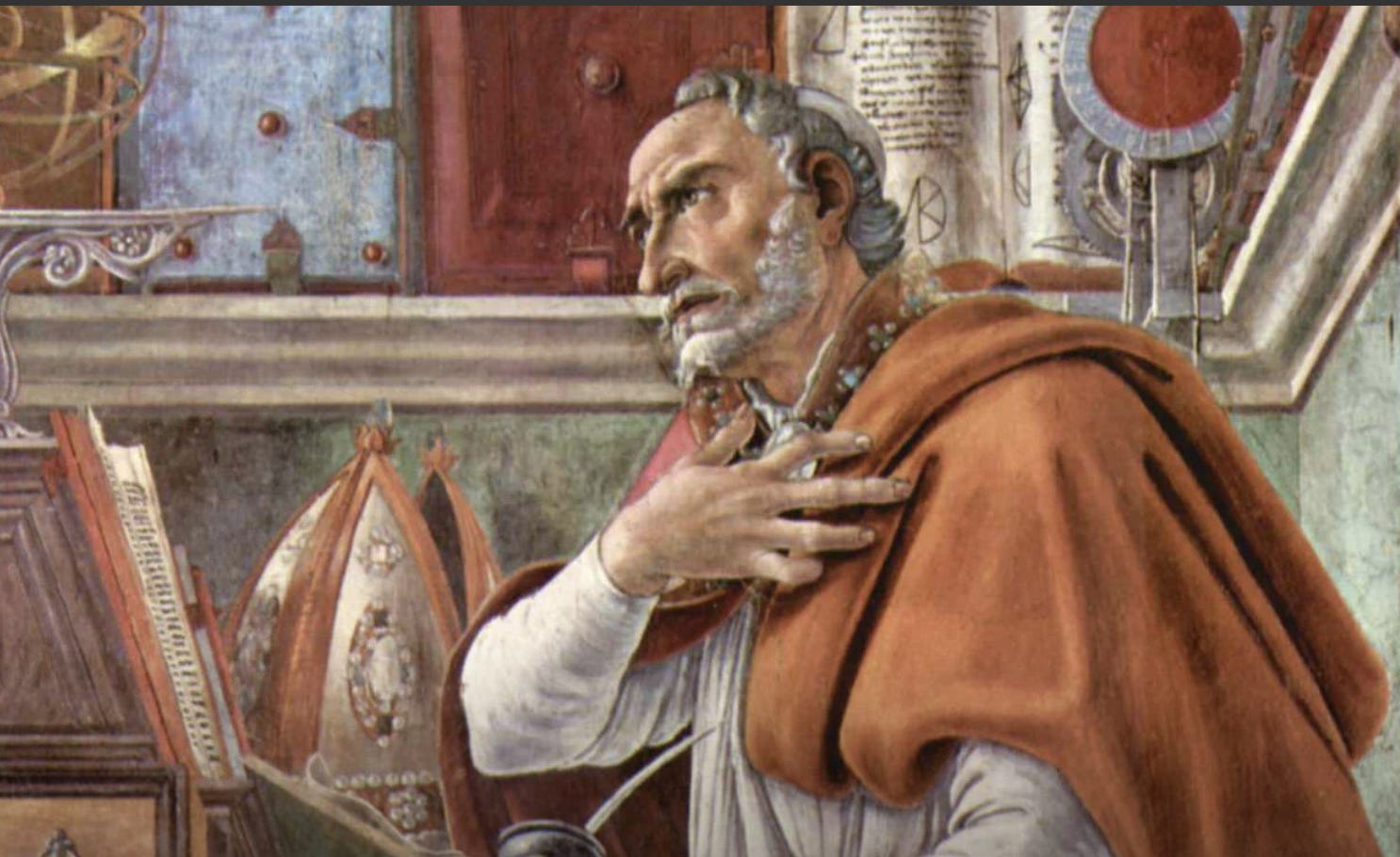
The Confessions is usually called the founding text of the inner life, and fairly so. Augustine discovers that the self is not transparent to itself. “I have become a problem to myself,” he writes. The human being is no longer a clear-eyed agent who occasionally errs. He is divided — full of memory, desire, resistance, and evasion.
But that is not the decisive insight.
Augustine does not turn inward to understand himself. He turns inward because that is where he must be turned. The problem he has become is not solved by analysis. It is solved by reorientation: away from disordered loves, toward the truth that made him.
Even his most quoted line is easy to misread. “Do not go outside; return into yourself; truth dwells in the inner man.” The point is not that the self owns the truth. It is that, in the depths of the self, one meets a truth that is not the self. God is “more inward than my inmost self” — and, Augustine adds in the same breath, “higher than my highest.” The inward road leads to Someone above.
So the movement inward is never mere observation. It is a place of encounter. You do not simply look at yourself. You stand before the truth, which you must choose whether to accept or refuse.
The inner life, from the beginning, is the place where conversion happens.
2. The Desert: The Inner Life as a Battlefield
An insight is not yet a way of life. Something had to make Augustine’s conversion sustainable.
Much of christian insight on sustaining a radical orientation toward the transcendent begins in the desert. When the age of the martyrs ended, the Christian struggle did not end with it. It moved. The arena outside became an arena within.
For Evagrius Ponticus, the monk is still a combatant. His enemy is no longer the persecutor but the logismoi — the thoughts that rise in the soul and pull it toward gluttony, anger, sadness, acedia, pride. The work is not to watch these thoughts with interest. It is to discern them, resist them, and reorder the heart. Virtue is forged in that fight.
The monastery is the form of life built to sustain it. The hours of prayer interrupt distraction. Obedience breaks self-will. A common rule keeps effort steady when fervor fades.
This was a real achievement. The inner life became not only intelligible but practicable. And notice what it was for: not self-knowledge as a hobby, but a life that could sustain in a coherent way a profound orientation toward God.
3. The Devotio Moderna: When Combat Becomes Method
The monastery could not hold everyone. As Christendom grew urban and literate, a question pressed: how do you live this seriously in the world?
The late-medieval devotio moderna — Geert Groote, the Brethren of the Common Life, Thomas à Kempis — gave a brilliant answer. It took the monastic disciplines and made them portable: daily examination of conscience, spiritual reading, personal notebooks, mutual accountability. They didn’t need a cloister. They needed habits.
They democratized devotion. That is no small thing.
But it opened a crack. Practices meant to serve a fight could be taken up apart from the fight. Vigilance against thoughts could become a habit of tracking them. The decisive moment — resist, renounce, turn — could be replaced by gradual, endless observation.
The soul, instead of being confronted, could be managed.
Samuel Johnson saw the comedy in this. Boswell records his delight at the published diary of John Rutty, a Dublin Quaker physician who kept, for over twenty years, a minute register of the state of his mind. Entries like:
“Indulgence in bed an hour too long.” “A little swinish at dinner and repast.” “Mechanically and sinfully dogged.”
Johnson laughed heartily. But this was not a secular sneer. Johnson was a serious Christian and an anxious penitent. His was the laugh of a man who knew what the inner life is for — and could see it being spent on the careful notation of crankiness.
Rutty’s problem was not insincerity. It was that the vigilance had become its own end. He monitored his soul without succeeding to change it. You can be extremely attentive to yourself and never be transformed.
4. Kierkegaard: The Hall of Mirrors
By the nineteenth century, Christianity in Copenhagen was everywhere and nowhere — familiar, cultural, undemanding. The vocabulary of inwardness survived. The urgency did not.
Kierkegaard names the condition. He calls it the aesthetic life. The aesthete is not necessarily shallow. He may be brilliant, reflective, even drawn to religion. What he lacks is the either/or. He watches his own inner life the way an audience watches a play: savoring moods, curating impressions, reflecting on his reflections. He has swapped the experience of depth for depth itself.
Kierkegaard’s diagnosis has a name for where this ends: infinite reflection. I am aware of myself, then aware of that awareness, then aware of that — a hall of mirrors with no exit. It feels like unusual seriousness. In fact, reflection has become a substitute for the act it was meant to prepare.
The cure is not less thought. It is thought willing to conclude. It is decision.
For Kierkegaard, the self is not a thing you find. It is a relation that must be rightly ordered — a self that relates to itself and, in doing so, stands before God. The self is not a fact but a task. And no method can perform that task for you. A technique addresses a type. Only hiin Enkelte — “that single individual” — stands before the truth and answers.
That is why Kierkegaard distinguishes recollection from repetition. Recollection looks backward and deepens without going anywhere. Repetition is the forward movement of a life taken up again after the crisis of choice. An inner life that endlessly catalogues itself is still recollection, however much it feels like progress.
Introspection, in other words, belongs to the drama of existence. One looks inward not to describe oneself, but to face the question of what one is to become — and to answer it.
5. Nietzsche: Attacking the Residue
Nietzsche arrives late — and that matters. He does not meet the Augustinian drama of conversion in its fullness. He meets what is left of it once its purpose has been forgotten: a thin, moralizing inwardness already sliding toward self-surveillance.
That is what he attacks.
In the Genealogy of Morals, instincts that cannot discharge outward turn inward. The result is “bad conscience”: a self divided against itself, reading its own inner conflict as guilt. The soul becomes a courtroom where instinct is always the defendant.
There is real insight here. Inwardness can shrink. Examination can curdle into fixation. A moral life meant to be ordered toward truth can be reorganized around self-accusation. Anyone who has known a scrupulous soul knows Nietzsche is not inventing this.
But he makes a decisive mistake. He takes a degeneration of the inner life for its essence.
Deeper still, Nietzsche has no category for conversion. He can describe guilt, but not repentance. He can describe division in the self, but not its healing by being rightly ordered to the truth. So every inward turn looks to him like repression; none looks like reorientation.
And notice: he doesn’t abandon introspection. He demands it — ruthlessly. Look inward to expose your drives, strip away illusion, overcome yourself. The aim is no longer conversion but self-creation.
Nietzsche sees the descent with brutal clarity. He cannot see the ascent.
6. Andreessen: Momentum Without Direction
Now we come back to Silicon Valley.
If inwardness has become either therapeutic self-expression or anxious self-surveillance, it’s no surprise that someone would want to drop it altogether. Build. Ship. Execute.
And Andreessen has a point. Much of what passes for introspection today is empty:
It mistakes the naming of feelings for the grasping of truth.
It swaps discipline for expression.
It turns the inner life into a performance.
That is Rutty’s diary with a ring light.
But the alternative to bad introspection is not neutrality. It is blindness.
Any serious change — religious, moral, even intellectual — requires an inward judgment: the way I am going is wrong, and I must turn. Without that judgment, action doesn’t produce greatness. It produces momentum.
And momentum is not direction.
7. What the Convert Knows
This brings us back to the converts.
It is tempting to explain them sociologically: the beauty of the liturgy, political reaction, a hunger for structure. None of that is false. All of it is insufficient.
A conversion is a judgment about the truth, and about oneself in relation to it. It means admitting error, letting go of positions one held, and accepting a form of life that cannot be reduced to prior preferences. That is impossible without inwardness.
But not just any inwardness. Not the diffuse self-attention of therapeutic culture. Not the self-monitoring that turns the soul into a project. Rather, what Augustine lived and Kierkegaard recovered: the willingness to stand before the truth and be changed by it.
The convert does not merely use the inner life. He shows what it is for.
The missing piece: order
Kierkegaard shows that the self must be taken up in decision. He says less about the measure by which it is rightly ordered. For that we go back to Thomas Aquinas.
For Aquinas, we are not immediately transparent to ourselves. We come to know ourselves through our acts, and our acts are intelligible only by their end. The inner life, then, is neither repression nor self-invention. It is the place where action is measured against the good, and where the will is formed to want it.
Cut inwardness off from that end, and it collapses — into repression, as Nietzsche saw, or into technique, as Rutty shows. Keep it ordered to the good, and what looks like constraint turns out to be the condition of freedom.
We have not lost introspection. We have lost its end.
So here is the harder path, harder than therapy and harder than “move fast”:
Go inward — but not to stay there. Examine yourself — but not to narrate yourself. Face the truth — not as an exercise, but as a demand. Then go outward, turned.
Andreessen is right that much introspection is empty. Nietzsche is right that inwardness can rot. But both miss the deeper thing. Without the inner life, a person does not become strong. He loses the capacity to turn.
The convert knows this the only way it can be known — by having turned his life another way, by taking responsibility for his own choices, by turning away from apparent goods to the only good that can satisfy his soul, the supreme good, God. And a culture that forgets how to turn has not escaped weakness. It has simply made transformation unintelligible.