

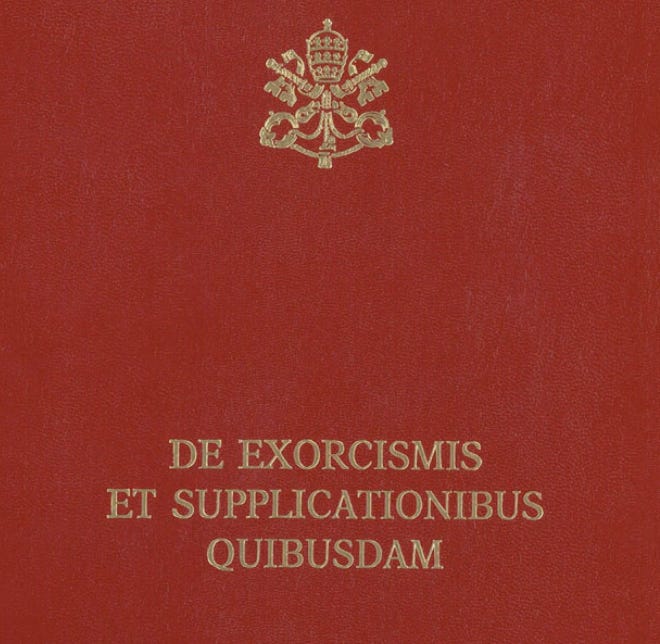
In recent years there has been a marked growth of interest among the laity concerning exorcism, spiritual warfare, and the demonic. Several well-known exorcists have appeared on popular podcasts, YouTube channels, and in print interviews, bringing themes once treated with considerable reserve into much broader public discussion.
At the same time, much of this discussion takes place without direct reference to the Church’s own liturgical and theological norms governing exorcism. The Praenotanda — the General Introduction prefacing the 1998 Rite of Exorcism (De Exorcismis et Supplicationibus Quibusdam) — remain surprisingly inaccessible in English, despite their importance for understanding how the Church herself frames these questions.
For this reason I have prepared and published here an English translation of the Praenotanda. The text is notable for its sobriety, theological clarity, pastoral caution, and repeated insistence upon prudence, discernment, sacramental life, and the absolute primacy of Christ’s victory over the powers of darkness.
The document is especially striking for the restraint with which it approaches extraordinary phenomena. It repeatedly warns against sensationalism, superstition, credulity, curiosity, and the transformation of exorcism into spectacle. It also insists upon careful discernment between genuine demonic influence and psychological illness, and places the ministry of exorcism firmly within the broader sanctifying mission of the Church.
Whatever one’s views regarding contemporary discussions surrounding exorcism, these norms deserve to be read directly and carefully. They provide an important theological and pastoral framework that is often absent from popular treatments of the subject.
PROEMIUM
In the history of salvation there are angelic creatures, some of whom serve the divine plan and offer mysterious and powerful assistance to the Church; others, however, having fallen from their original dignity and called diabolical, oppose the will and saving action of God accomplished in Christ and seek to associate man with their rebellion against God.¹
In Sacred Scripture the Devil and the demons are designated by various names, some of which in a certain way indicate their nature and activity.² The Devil, also called Satan, is referred to as the ancient serpent and the dragon. It is he who seduces the whole world and wages war against those who keep the commandments of God and bear witness to Jesus (Rev 12:9, 17). He is called the enemy of mankind (1 Pet 5:8) and a murderer from the beginning (cf. Jn 8:44), because through sin he made man subject to death. Because by his snares he leads man into disobedience against God, he is called the Evil One and the Tempter (cf. Mt 4:3; 26:36–44), a liar and the father of lies (cf. Jn 8:44), one who acts with cunning and falsehood, as is attested by the seduction of our first parents (cf. Gen 3:4, 13), by the attempt to turn Jesus away from the mission received from the Father (cf. Mt 4:1–11; Mk 1:13; Lk 4:1–13), and by his disguising himself as an angel of light (cf. 2 Cor 11:14). He is also called the prince of this world (cf. Jn 12:31; 14:30), that is, the ruler of that world which lies under the power of the Evil One (cf. 1 Jn 5:19) and has not known the true Light (cf. Jn 1:9–10). His power is described as the power of darkness (cf. Lk 22:53; Col 1:13), because of the hatred he bears toward the Light, who is Christ, and because of his effort to draw men into his own darkness. But the Devil and the demons, allied together in opposition to the sovereignty of God (cf. Jude 6), have received condemnation (cf. 2 Pet 2:4) and constitute the army of evil spirits (cf. Eph 6:12). Although created as spiritual beings, they sinned and are also called the angels of Satan (cf. Mt 25:41; 2 Cor 12:7; Rev 12:7, 9). This may suggest that some particular mission has been entrusted to them by their wicked prince.³
The entire activity of these unclean, wicked, and deceitful spirits (cf. Mt 10:1; Mk 5:8; Lk 6:18; 11:26; Acts 8:7; 1 Tim 4:1; Rev 18:2) has been destroyed by the victory of the Son of God (cf. 1 Jn 3:8). Even though “the whole of human history has been pervaded by a tremendous struggle against the powers of darkness that will continue until the last day,”⁴ Christ, through the Paschal Mystery of his death and resurrection, “has rescued us from the slavery of Satan and sin,”⁵ destroying their dominion and freeing all things from the contagion of evil. And since the devastating and hostile activity of the Devil and demons affects persons, things, and places, manifesting itself in various ways, the Church, always conscious that “the days are evil” (Eph 5:16), has prayed and continues to pray that men may be delivered from the snares of the Evil One.
¹ Cf. Catechism of the Catholic Church, nn. 332, 391, 414, 2851.
² Ibid., nn. 391–395, 397.
³ Ibid., n. 394.
⁴ Second Vatican Council, Gaudium et Spes, n. 37.
⁵ Ibid., n. 22.
GENERAL INTRODUCTION
I. The Victory of Christ and the Power of the Church over Demons
II. Exorcisms in the Sanctifying Mission of the Church
III. Minister and Conditions for the Major Exorcism
IV. Description of the Rite
V. Adaptations Pertaining to the Exorcist
VI. Adaptations Within the Competence of the Episcopal Conference
I. THE VICTORY OF CHRIST
AND THE POWER OF THE CHURCH OVER DEMONS
1. The Church firmly believes that there is one true God alone, Father, Son, and Holy Spirit, one principle, creator of all things visible and invisible.⁶ Everything that He has created (cf. Col 1:16), God in His providence preserves and governs.⁷ Nothing has He made that is not good.⁸ Even “the devil (...) and the other demons were created by God naturally good, but they became evil by their own doing.”⁹ They too would be good had they remained in the state in which they were created; but having abused their natural perfection and not persevered in the truth (cf. Jn 8:44), though without changing their nature, they separated themselves from the supreme Good to whom they ought to have remained faithful.¹⁰
2. Man was created in the image of God “in true righteousness and holiness” (Eph 4:24), and his dignity requires that he act according to conscious and free choices.¹¹ But, instigated by the Evil One, he misused the gift of freedom and, through the guilt of his disobedience (cf. Gen 3; Rom 5:12), fell under the power of the devil and of death and became a slave to sin.¹² As a consequence, “the whole of human history has been pervaded by a tremendous struggle against the powers of darkness; a struggle begun from the very origins of the world and destined to continue, as the Lord says (cf. Mt 24:13; 13:24–30, 36–43), until the last day.”¹³
3. The almighty and merciful Father sent into the world His beloved Son to free men from the power of darkness and transfer them into His kingdom (cf. Gal 4:5; Col 1:13). Thus Christ, “the firstborn of all creation” (Col 1:15), in order to renew the old man, clothed Himself in sinful flesh “that through death He might destroy the one who has the power of death, that is, the devil” (Heb 2:14); through the gift of the Holy Spirit He restored wounded human nature to the condition of a new creation by means of His Passion and Resurrection.¹⁴
4. During His earthly life the Lord Jesus, victor over temptation in the desert (cf. Mt 4:1–11; Mk 1:12–13; Lk 4:1–13), by His authority cast out Satan and the other demons, imposing His will upon them (cf. Mt 12:27–29; Lk 11:19–20). By doing good and healing all who were under the power of the devil (cf. Acts 10:38), He made manifest the work of His salvation destined to free man from sin and its consequences, as well as from the author of the first sin, a murderer from the beginning and the father of lies (cf. Jn 8:44).¹⁵
5. When the hour of darkness arrived, the Lord, “becoming obedient unto death” (Phil 2:8), repelled the supreme assault of Satan (cf. Lk 4:13; 22:53) through the mysterious power of the Cross,¹⁶ thereby triumphing over the pride of the ancient adversary. The victory of Christ was manifested in His glorious Resurrection, when God raised Him from the dead and seated Him at His right hand in the heavens, subjecting all things beneath His feet (cf. Eph 1:21–22).
6. During His ministry Christ gave the Apostles and the other disciples the power to cast out unclean spirits (cf. Mt 10:1, 8; Mk 3:14–15; 6:7, 13; Lk 9:1; 10:17–20). He promised them the Holy Spirit, the Paraclete, who proceeds from the Father through the Son, in order to convict the world concerning judgment, because the ruler of this world has been judged (cf. Jn 16:7–11). And in the Gospel the casting out of demons forms part of the signs that would accompany those who believe (cf. Mk 16:17).
7. From the time of the Apostles the Church has exercised the power received from Christ to cast out demons and repel their influence (cf. Acts 5:16; 8:7; 16:18; 19:12). Therefore she prays with confidence and perseverance “in the name of Jesus” to be delivered from the Evil One (cf. Mt 6:13),¹⁷ and, in that same name, by the power of the Holy Spirit, she commands demons in various ways not to hinder the work of evangelization (cf. 1 Thess 2:18) and to restore to “the Stronger One” (cf. Lk 11:21–22) dominion over creation and over every man. “When the Church publicly and authoritatively commands in the name of Jesus Christ that a person or object be protected against the influence of the Evil One and withdrawn from his dominion, this is called exorcism.”¹⁸
II. EXORCISMS
IN THE SANCTIFYING MISSION OF THE CHURCH
8. By a most ancient and uninterrupted tradition, the Church has ordered the path of Christian initiation in such a way as clearly to express and effectively to begin the spiritual struggle against the power of the devil (cf. Eph 6:12). The exorcisms performed in simple form over the elect during the catechumenate, namely the minor exorcisms,¹⁹ are prayers by which the Church asks that they become conscious of the mystery of Christ who frees from sin, be delivered from the consequences of sin and from diabolical influence, be strengthened in their spiritual journey, and open their hearts to receive the grace of the Savior.²⁰
In the celebration of Baptism, moreover, those to be baptized renounce Satan, his works, and his seductions, and oppose to him their faith in the one and triune God. Even in the Baptism of infants, prayers of exorcism are recited, asking that, protected against the allurements of the world and in the struggle against the snares of the devil, they may be strengthened by the grace of Christ throughout the course of their lives.²¹ Through the Baptism that regenerates him, man participates in Christ’s victory over the devil and sin, passing “from the condition in which he is born a child of the first Adam to the state of grace and adoption as a son of God through the second Adam, Jesus Christ.”²² In this way he obtains liberation from the slavery of sin by means of that freedom with which Christ has set us free (cf. Gal 5:1).
9. The faithful, even though reborn in Christ, nevertheless experience the temptations of the world. Therefore they must remain vigilant through prayer and sobriety of life, because their enemy, “the devil, prowls around like a roaring lion seeking someone to devour” (1 Pet 5:8). They must resist him, firm in faith, “strengthened by the Lord and by the might of His power” (Eph 6:10), and sustained by the prayer of the Church, through which she asks that her children may be secure from every disturbance.²³ Through the grace of the sacraments, and especially through frequent celebration of Penance, they gain strength to attain the full freedom of the children of God (cf. Rom 8:21).²⁴
10. More difficult for us to understand is the plan of divine mercy when, by God’s permission, there occurs a particular vexation or possession by the devil against a member of the people of God whom Christ has enlightened to walk toward eternal life as a child of light. Then the mystery of iniquity at work in the world (cf. 2 Thess 2:7) manifests itself with particular clarity (cf. Eph 6:12), even though the devil cannot surpass the limits established by God.²⁵ This form of the devil’s power over man differs from that which derives from original sin, which is sin in the fullest sense.²⁶ In these circumstances the Church intervenes imploring Christ the Lord and Savior and, sustained by His power, offers various helps to the faithful person tormented or possessed by the Evil One so that he may be freed from diabolical vexation or obsession.
11. Among these helps, solemn exorcism holds a special place. It is a liturgical celebration, also called the “major exorcism.”²⁷ Exorcism, which “is directed at the expulsion of demons or liberation from demonic influence through the spiritual authority which Jesus Christ entrusted to His Church,”²⁸ is a prayer belonging to the category of sacramentals, that is, a sacred sign through which “effects, especially spiritual ones, are signified and obtained through the intercession of the Church.”²⁹
12. In major exorcisms the Church, united to the Holy Spirit, implores that same Spirit to come to the aid of our weakness (cf. Rom 8:26), to cast out demons and prevent them from harming the faithful. Trusting in the breath with which the Son of God, after the Resurrection, bestowed the Spirit, the Church acts in exorcisms not in her own name but solely in the name of God or of Christ the Lord, to whom all beings — including the devil and demons — must be obedient.
III. MINISTER AND CONDITIONS
FOR THE MAJOR EXORCISM
13. The ministry of exorcising persons possessed by the Evil One is entrusted by special and express permission of the local Ordinary, ordinarily the diocesan Bishop.³⁰ Such permission is to be granted only to priests distinguished by piety, learning, prudence, and integrity of life,³¹ and specifically prepared for this office. The priest to whom the ministry of exorcist is entrusted, whether stably or ad actum, should carry out this work of charity with confidence and humility under the guidance of the diocesan Bishop. In this book the term “exorcist” always means “priest exorcist.”
14. In cases of an intervention thought to be diabolical, the exorcist must first of all exercise the necessary and utmost caution and prudence. Above all, he should not immediately believe that he is dealing with a person possessed by the demon, since it could be a case of illness, especially of a psychological nature.³² Likewise, he should not immediately conclude that there is diabolical possession when the person claims to be especially tempted, depressed, or tormented, since this may be the fruit of imagination. In order not to fall into error, he should also pay attention to the methods and cunning by which the devil deceives man, persuading the faithful person tormented by the Evil One that he has no need of exorcism and making him believe that his illness is natural and curable by medicine. In every case, the exorcist should carefully determine whether the person who believes himself tormented by the demon truly is so.
15. He should carefully distinguish cases of diabolical aggression from those arising from a certain credulity, which leads some persons, even among the faithful, to believe themselves the object of spells, curses, or maledictions cast upon them, their relatives, or their possessions by others. He should not deny them spiritual assistance, but he must absolutely avoid resorting to exorcism. He may instead say suitable prayers with them and for them, so that they may recover the peace of God. Spiritual assistance should likewise not be denied to the faithful who, although not touched by the Evil One (cf. 1 Jn 5:18), nevertheless suffer from his temptations while remaining resolved to be faithful to the Lord Jesus and the Gospel. This may also be done by a priest who is not an exorcist, or even by a deacon, using appropriate prayers and supplications.
16. The exorcist should not proceed to the celebration of exorcism in the imperative form unless he has moral certainty that the person to be exorcised is truly possessed by the demon,³³ and, insofar as possible, he should not proceed without the person’s consent.
According to established practice, signs of diabolical possession are considered to include: speaking unknown languages fluently or understanding those who speak them; revealing hidden and distant things; displaying strength beyond one’s age or physical condition. These, however, are signs that may constitute only indications and therefore are not necessarily to be regarded as originating from the demon. Attention must therefore also be paid to other signs, especially of a moral and spiritual order, which manifest diabolical intervention in another way. Such signs may include: violent aversion toward God, the Most Holy Person of Jesus, the Blessed Virgin Mary, the Saints, the Church, the Word of God, sacred realities — especially the sacraments — and sacred images. Careful attention must be paid to the relationship between all these signs and faith and spiritual commitment in Christian life; for the Evil One is above all the enemy of God and of whatever places the faithful in contact with the saving action of God.
17. The exorcist shall decide prudently regarding the necessity of recourse to the Rite of Exorcism after careful examination, always preserving the secrecy of Confession, and after consulting, insofar as possible, persons expert in spiritual matters and, if necessary, persons expert in medicine and psychiatry who are also competent in spiritual realities.
18. In cases involving non-Catholics and in other particularly difficult cases, recourse should be made to the diocesan Bishop, who, for prudence’s sake, may request the opinion of several experts before deciding whether an exorcism should be performed.
19. Exorcism should be carried out in such a way that it manifests the faith of the Church and prevents it from being interpreted as an act of magic or superstition.
Care should be taken that it does not become a spectacle for those present. During the celebration of the exorcism, means of social communication are not to be admitted, and both before and after the rite the exorcist and those present are to avoid spreading news of it, maintaining appropriate discretion.
IV. DESCRIPTION OF THE RITE
20. In the Rite of Exorcism, particular importance is to be given not only to the proper formulas of exorcism, but also to the gestures and rites that derive their meaning and value from their use in the catechumenal itinerary during the period of purification. These are the sign of the Cross, the imposition of hands, the exsufflatio, and the sprinkling with blessed water.
21. The rite begins with the sprinkling of blessed water. Through this, understood as a memorial of the purification received in Baptism, the faithful person tormented by the Evil One is defended against the snares of the enemy.
The water may be blessed before the rite or during its celebration, adding salt also, if this is deemed appropriate.
22. The litanies follow, by which, through the intercession of all the Saints, the mercy of God is invoked upon the faithful person tormented by the Evil One.
23. After the litanies, the exorcist may recite one or more psalms that implore the protection of the Most High and exalt the victory of Christ over the Evil One. The psalms may be recited consecutively or in responsorial form. At the end of the psalm the exorcist may add the oratio super psalmum.
24. There follows the proclamation of the Gospel, a sign of the presence of Christ, who, through the proclamation of His word in the Church, comes to meet the sufferings of men.
25. Then the exorcist imposes hands upon the faithful person tormented by the Evil One, invoking the power of the Holy Spirit so that the devil may depart from the one who, from Baptism, has been made a temple of God. He may also breathe toward the face of the faithful person tormented by the Evil One.
26. The Creed is recited, or the baptismal promises are renewed with the renunciation of Satan. The Lord’s Prayer follows, by which God our Father is implored to deliver us from the Evil One.
27. After this, the exorcist shows the faithful person tormented by the Evil One the Cross of the Lord, source of every blessing and every grace, and traces upon him the sign of the Cross, to signify the power of Christ over the devil.
28. Then he says the invocative formula of supplication to God and the imperative formula of direct command to the demon, in the name of Christ, to leave the faithful person tormented by the Evil One. The imperative formula is not to be used unless preceded by the invocative formula. The invocative formula, however, may be used without the imperative formula.
29. What precedes may, if necessary, be repeated either during the same celebration, bearing in mind the possibilities suggested in no. 34, or at different times, until the faithful person tormented by the Evil One is completely liberated.
30. The rite concludes with a hymn of thanksgiving, the prayer, and the blessing.
V. ADAPTATIONS PERTAINING TO THE EXORCIST
31. The exorcist, remembering that the demon cannot be cast out except by prayer and fasting, should take care, following the example of the holy Fathers, to have recourse to these two means in order to obtain the help of God, both personally and on the part of others.
32. The faithful person tormented by the Evil One should, if possible, especially before the exorcism, pray to God, practice mortification, frequently renew the faith received in Baptism, often approach the sacrament of Reconciliation, and receive the Eucharist. Family members, friends, the confessor, or the spiritual director may assist him in prayer, if prayer is made easier for him by the help that comes from the charity and closeness of other faithful.
33. The exorcism should be performed, insofar as possible, in an oratory or another suitable place, avoiding the presence of many people. The image of the Crucified Lord should be prominent. An image of the Blessed Virgin Mary should also be present.
34. Taking into account the condition of the faithful person tormented by the Evil One and the circumstances, the exorcist should freely make use of all the possibilities that the rite allows him. In the celebration, therefore, he should preserve the general structure, but choose and arrange formulas and prayers according to necessity, adapting them to the situation of the persons involved.
a) First of all, he should pay attention to the physical and psychological condition of the faithful person tormented by the Evil One, which may vary during the course of the day or within a few hours.
b) When there is no assembly of the faithful present, however small, whose presence is in itself required by wisdom and prudence, the exorcist should not forget that already in his own person and in that of the faithful person tormented by the Evil One the Church is present. He should also remind the faithful person tormented by the Evil One of this.
c) He should see to it that, during the exorcism, insofar as possible, the faithful person tormented by the Evil One remains recollected, turned toward God, and asks Him for liberation with firm faith and complete humility. In the most critical moments, he should help him to resist with patience, without doubting the help of God, sustained by the ministry of the Church.
35. If certain qualified persons are admitted to the exorcism, they too should be exhorted to pray intensely for the brother tormented by the demon, whether individually or in the forms indicated by the rite. They must, however, abstain from every formula of exorcism, whether invocative or imperative, which is reserved to the exorcist alone.
36. It is fitting that the faithful person, once liberated, either alone or with his family members, give thanks to God for the peace obtained. He should be accompanied so that he may persevere in prayer, drawn especially from Sacred Scripture, frequent the sacraments of Penance and the Eucharist, and practice a Christian life rich in works of charity and fraternal love.
VI. ADAPTATIONS WITHIN THE COMPETENCE
OF THE EPISCOPAL CONFERENCE
37. It belongs to the Episcopal Conference:
a) to prepare an integral and faithful translation of the texts;
b) if necessary or useful, according to the culture and character of the various peoples, to introduce adaptations in signs and gestures, with the consent of the Holy See.
38. In addition to the version — which must be integral — of the General Introduction, a pastoral Directory for the use of the major exorcism may be added, if the Episcopal Conference judges it opportune. Such a Directory should help exorcists to understand and assimilate more deeply the doctrine of the General Introduction, and may provide them with a collection of documents on the manner of acting, speaking, questioning, and judging, drawn from authors of sound doctrine. These Directories, in whose composition priests rich in learning and of proven experience in the long exercise of the ministry of exorcists, practiced in different places and cultures, may collaborate, must be approved by the Holy See, according to the norm of law.
NOTES
⁶ Cf. Fourth Lateran Council, chap. I, De fide catholica, Denz.-Schönm. 800; cf. Paul VI, Profession of Faith: AAS 60 (1968), 436.
⁷ Cf. First Vatican Council, Dogmatic Constitution Dei Filius on the Catholic Faith, chap. I, De Deo rerum omnium creatore, Denz.-Schönm. 3003.
⁸ Cf. St. Leo the Great, Letter Quam laudabiliter to Turibius, chap. 6, De natura diaboli, Denz.-Schönm. 286.
⁹ Fourth Lateran Council, chap. I, De fide catholica, Denz.-Schönm. 800.
¹⁰ Cf. St. Leo the Great, Letter Quam laudabiliter to Turibius, chap. 6, De natura diaboli, Denz.-Schönm. 286.
¹¹ Cf. Second Vatican Council, Pastoral Constitution on the Church in the Modern World, Gaudium et Spes, n. 17.
¹² Cf. Council of Trent, Session V, Decree on Original Sin, nn. 1–2, Denz.-Schönm. 1511–1512.
¹³ Second Vatican Council, Pastoral Constitution on the Church in the Modern World, Gaudium et Spes, n. 37; cf. ibid., n. 13; 1 Jn 5:19; Catechism of the Catholic Church, nn. 401, 407, 409, 1717.
¹⁴ Cf. 2 Cor 5:17.
¹⁵ Cf. Catechism of the Catholic Church, nn. 517, 549–550.
¹⁶ Cf. Roman Missal, Preface I of the Passion.
¹⁷ Cf. Catechism of the Catholic Church, nn. 2850–2854.
¹⁸ Catechism of the Catholic Church, n. 1673.
¹⁹ Cf. Roman Ritual, Rite of Christian Initiation of Adults, n. 101; cf. Catechism of the Catholic Church, n. 1673.
²⁰ Cf. ibid., n. 156.
²¹ Cf. Roman Ritual, Rite of Baptism of Children, nn. 56, 104.
²² Council of Trent, Session VI, Decree on Justification, chap. IV, Denz.-Schönm. 1524.
²³ Roman Missal, Embolism after the Lord’s Prayer.
²⁴ Cf. Gal 5:1; Roman Ritual, Rite of Penance, n. 7.
²⁵ Cf. John Paul II, Apostolic Exhortation Reconciliatio et Paenitentia, nn. 14–22: AAS 77 (1985), 206–207; Encyclical Dominum et Vivificantem, n. 18: AAS 78 (1986), 826.
²⁶ Cf. Council of Trent, Session V, Decree on Original Sin, canons 4 and 5, Denz.-Schönm. 1514–1515.
²⁷ Cf. Catechism of the Catholic Church, n. 1673.
²⁸ Cf. ibid.
²⁹ Second Vatican Council, Constitution on the Sacred Liturgy, Sacrosanctum Concilium, n. 60.
³⁰ Cf. Code of Canon Law, can. 1172 §1.
³¹ Ibid., §2.
³² Cf. Catechism of the Catholic Church, n. 1673.
³³ Cf. Benedict XIV, Letter Sollicitudini, 1 Oct. 1745, n. 43; cf. 1917 Code of Canon Law, can. 1152 §2.