The lectionary this week weaves together Amos, the Psalmist, Paul, and the Lukan parable of the rich man and Lazarus. Taken as a whole, the readings insist that Christian existence is measured not by comfort, but by conformity to God’s compassion.
Amos and the ruin of Joseph
Amos speaks to a society at ease. “Woe to those who lie upon ivory couches… who drink wine from bowls… but are not grieved over the ruin of Joseph” (Am 6).
The denunciation targets indifference. “Joseph” here is shorthand for the northern tribes—Ephraim, son of Joseph, being the largest, all are grouped together under his name. The prophet’s charge is not against wealth as such—Scripture remembers Abraham and Solomon as wealthy—but against wealth detached from fidelity to God and responsibility for the community. Luxury that dulls compassion is a sign that Israel’s identity is being forgotten. The poor men at the gates are also sons of Abraham. Amos proclaims that exile will be the inevitable consequence.
The Psalm: divine memory
Psalm 146 answers the prophet’s lament with a description of divine kingship:
“The Lord keeps faith forever, gives bread to the hungry, sets the prisoners free.”
Where human rulers fail, God remembers. Where the rich forget, God upholds. The Psalm thus places Amos’s indictment within a wider frame: the divine order is one of mercy, and Israel’s task is to reflect that order.
Paul to Timothy: fidelity and the permanent things
Paul exhorts Timothy to “fight the good fight of faith, take hold of eternal life” (1 Tim 6). The vocabulary is not indulgence versus austerity but witness and endurance. Paul lists the virtues—faith, love, patience, gentleness—that sustain conformity to Christ.
Here I am reminded of what Russell Kirk called “the permanent things.” Kirk wrote of the conservative as one who believes in an enduring moral order, grounded in human nature and divine law. Human beings are not adrift in preference; they are made for what endures.
A modern Kirk—Charlie Kirk (no relation)—used the word “permanent” differently: he spoke of entrenched bureaucracies, wars, or habits that appeared immovable. He showed how many supposed “permanences” were false: illusions of political and cultural inertia that could and should be overturned. Instead of the real permanent things that Paul tells Timothy about, we can deceive ourselves into thinking that the permanent presence of the poor means that we can do nothing to alleviate their suffering. We become become convinced we can do “nothing” to help them.
Charlie Kirk also spoke often about what lasts. His most popular words were about Jesus, joy, and family. One of his most-shared posts simply read: “It’s all about Jesus.” It was liked more than 360,000 times. Another urged: “Tell someone about Jesus this weekend.” Over 50,000 people responded.
He liked to end his speeches with a simple litany:
Get married.
Have children.
Build a legacy.
Pass down your values.
Pursue the eternal.
Seek true joy.

So too Paul urges Timothy: endure in what abides. The exemplar is Christ, “who in his testimony before Pontius Pilate made the good confession.” To live faithfully is to share in Christ’s witness before impermanent power, stretched between baptismal beginning and eschatological consummation.
The parable: the Word names Lazarus
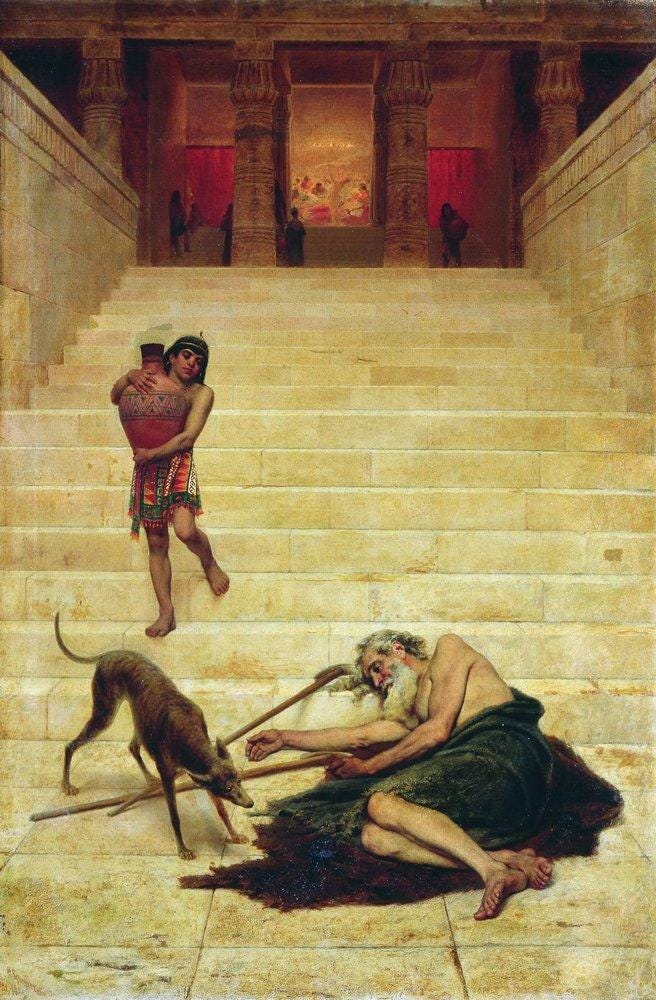
In this context, Luke’s parable comes into focus. A rich man—tradition calls him Dives—is clothed in purple, a royal fabric, and feasts daily. At his gate lies Lazarus, covered with sores, longing even for crumbs: scraps of bread used to wipe greasy fingers at banquets. Dogs, considered unclean, nevertheless show him more attention than his fellow man.
The death of both unveils a reversal. Lazarus is carried to Abraham’s bosom; Dives is buried and finds himself in torment. The gulf between them is fixed.
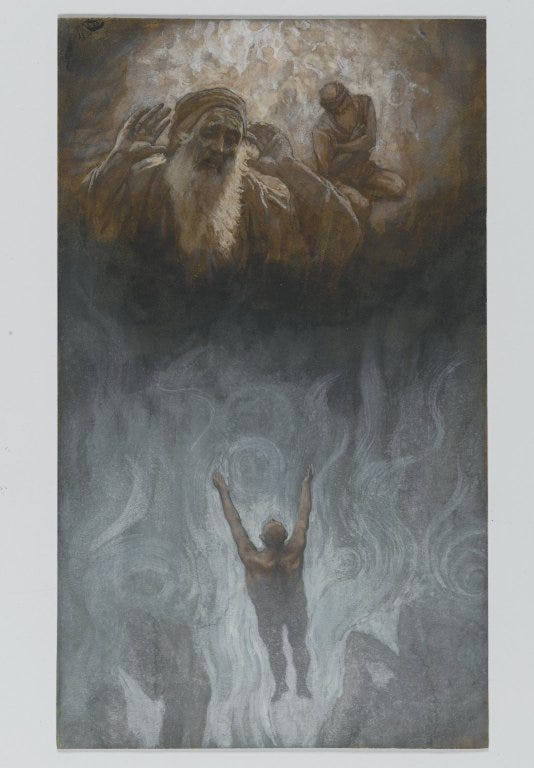
Here a detail deserves notice. Lazarus is the only named figure in any of Christ’s parables. The rich man’s name is forgotten; the poor man’s name is remembered, and it means God is my help. The Word Himself confers enduring identity not on those who possess luxury, but on the one who relies upon God.
Indifference as the true sin
William Barclay, the 20th-century Scripture scholar, notes that Dives is not condemned for cruelty. He did not drive Lazarus away. He simply never noticed. His sin was indifference—the failure even to perceive suffering at his threshold. It was not malice, but blindness that became his judgment.
This is why the parable is one of the New Testament’s most vivid depictions of the afterlife. Some traditions read it as hell, others as purgatory. Catholic commentators note telling details: Dives still calls Abraham Father, speaks with concern for his brothers, and appears to “pay back” a debt. But the precise geography is less decisive than the theological point. Whether in final damnation or penultimate purification, indifference to suffering now estranges us from mercy hereafter.
The witness of the saints
The Christian tradition offers a counter-image. Francis became poor to serve the poor. The healthy man embraced the leper. Mother Teresa sought for Christ “in the distressing disguise of the poor.”
And in God’s providence, St. Vincent de Paul, whose feast we celebrated this week, wrote:
“Even though the poor are often rough and unrefined, we must not judge them from external appearances nor from the mental gifts they seem to have received. On the contrary, if you consider the poor in the light of faith, then you will observe that they are taking the place of the Son of God who chose to be poor.”
The poor are not a backdrop to our moral drama; they are Christ present to us.

Mercy and the moral imagination
This parable appeals not to abstract argument but to the moral imagination. It is a story, and by entering its drama we begin to see ourselves differently. Dives is not only a man of antiquity but a mirror of our own age’s comfortable elites, insulated by consumption and distraction. The “ruin of Joseph” is visible today in broken families, neglected neighborhoods, and forgotten poor, even as many recline in ease.
For Kirk, the “permanent things” are disclosed here: mercy is eternal, indifference self-destructive. The saints preserve the imagination by embodying these truths. They remind us that our neighbor is not a landscape feature but the image of God.
Mercy at the gate
The parable leaves us with both warning and hope. The gulf in the next life is fixed. But the gate in this life is still open. Each time we notice, serve, and love the poor, we bridge the chasm. Each act of mercy is a step into the Kingdom.
Dives teaches us the danger of indifference. The saints teach us the joy of love. Who lies at our gate today? May we have eyes to see Christ in them—and so enter into the eternal mercy of God.