

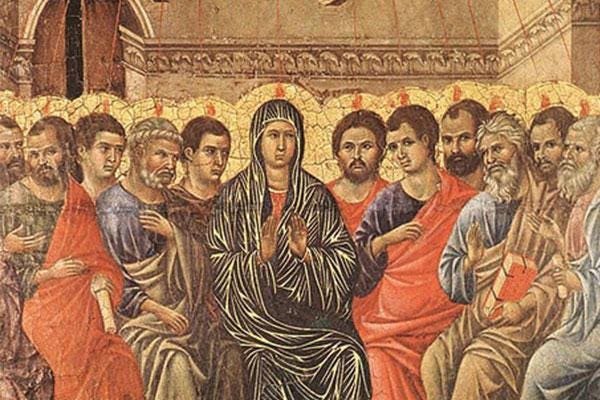
There is a question worth pondering: if you had to point to one person — one life — and say, there, that is Christ’s greatest disciple, that is what Christianity is actually about, who would it be?
Not the most dramatic convert. Not the most rigorous theologian. Not the mystic with the most extraordinary experiences. But the life that most fully, most quietly, most completely received what God was offering — and became what God was asking.
For two thousand years, Christians have given the same answer: Mary.
This is not a pious reflex. It is a theological claim, and a surprisingly radical one. Mary is not interesting primarily because of the miracles associated with her, or the apparitions, or the devotions. She is interesting because she represents the endpoint of the entire Christian spiritual tradition — the place where everything the desert fathers, the medieval mystics, the great reformers of religious life, and the Eastern contemplatives were all reaching toward actually arrived.
The Second Vatican Council placed its treatment of Mary not in a separate document, but in the final chapter of its most important constitution on the Church — Lumen Gentium. The location is deliberate. Mary is not an appendix to Christianity. She is its innermost logic.
✦ ✦ ✦
Beginning with Christ
All Marian theology begins with a question about Christ.
At the Council of Ephesus in 431, after a bitter controversy that threatened to fracture the Church, the bishops defined Mary as Θεοτόκος — God-bearer, Mother of God. This was not primarily a statement about Mary’s dignity. It was a statement about her Son’s identity. If the child she bore is truly and fully God — not a divine spirit inhabiting a human shell, but God himself made flesh — then she is truly and without qualification his mother. To deny Theotokos, as Nestorius did, was not to humble Mary. It was to divide Christ, to suggest that the divine and human in him were so separate that she could be the mother of one but not the other.
Every Marian privilege follows this same logic. Her greatness flows entirely from her union with the one she bore. She is the greatest disciple because of who her teacher is — and because of what he asked of her, and what she gave.
Which means that the closer you look at Mary, the more clearly you see Christ. She is not a rival center of attention. She is the clearest creaturely lens through which the mystery of the Incarnation comes into focus. The Eastern icon tradition grasped this intuitively: in every icon of the Theotokos, however Mary’s posture varies, the Christ-child is always at her center. She is always pointing toward him.
✦ ✦ ✦
The grammar of the spiritual life
This gives us something more than a historical point. It gives us the grammar of the Christian spiritual life itself.
The Annunciation has a shape. The Word comes. It is received in faith. And that reception bears fruit for others. Mary hears the Angel’s announcement, she responds — fiat — and from that response comes the salvation of humanity. This movement — reception of the Word, response in faith, fruitfulness for the world — is not unique to Mary. It is the structure of every Christian spiritual tradition, in every century and every school.
The Benedictine monk who gathers seven times a day to receive the Word in the Office and the Psalms. The Carmelite making herself available to God’s action in contemplative prayer. The Franciscan who hears the Gospel and empties himself to become its instrument. The Ignatian who discerns God’s voice in the movements of his own soul and says yes. The hesychast repeating the Jesus Prayer until the name of Christ has saturated every breath. In each case, the movement is the same: hear, receive, respond, bear fruit.
Mary is not one example of this pattern among others. She is its first and perfect instance — the one in whom it was enacted most completely, most freely, and with the most universal fruitfulness. Every school of Christian spirituality is, in its own idiom, trying to do what she did at the Annunciation.
But here is what strikes me: each of them is, in its own way, attempting to become Mary.
✦ ✦ ✦
Everything the tradition was looking for
Christianity has produced an extraordinary variety of spiritual schools, each emphasizing a different dimension of the life with God.
The Egyptian desert fathers of the fourth century developed a rigorous science of the interior life — learning to watch their own thoughts, identify the passions that drove them, and cultivate a deep stillness that made them receptive to God.
The Benedictine tradition that followed organized all of life around prayer, work, and sacred reading, on the conviction that time itself could be sanctified.
The Franciscans in the thirteenth century recovered evangelical poverty — the freedom of the person who owns nothing and therefore owes nothing, and so is available for everything.
The Dominicans pursued truth as a form of love, believing that the intellect itself, when ordered rightly, becomes a path to God.
The Carmelites — Teresa of Avila, John of the Cross — mapped the interior journey with psychological and mystical precision, including its most difficult passages: the darkness, the apparent abandonment, the slow purification that makes room for union.
The Jesuits developed a grammar of desire and discernment, helping people read the movements of their own souls to find where God was leading.
And the Christian East produced the hesychast tradition, with its Jesus Prayer and its conviction that the human body itself is capable of the divine light.
Each of these traditions is a real inheritance. Each has shaped millions of lives. Each has something irreplaceable to offer.
And each of them, when you press it to its deepest intention, is reaching toward the same thing: a human life transparent to God. A person who hears, receives, and bears fruit. A soul that has learned — through years of discipline, grace, and often suffering — to say fiat.
✦ ✦ ✦
The woman who listened
The desert fathers had a word for the foundational spiritual capacity: prosochē — attentiveness. Before you can respond to God, you have to be able to hear him. And hearing requires a kind of inner silence that does not come naturally. Most of us live at the surface of our own lives, driven by noise and reaction. The entire discipline of the desert — the long hours of stillness, the watchfulness over thoughts, the guarding of the heart — was ordered toward producing a person genuinely capable of attention.
Mary, at the Annunciation, is already that person.
The Gospel of Luke records her response with remarkable economy. The Angel speaks. She asks one question — not a question of doubt, but a genuine question of understanding: How can this be? And then: Fiat mihi secundum verbum tuum. Let it be done to me according to your word.
There is no qualification. No negotiation. No condition. The fiat is total — the most complete act of receptivity in human history. She is not overwhelmed. She is not passive in the bad sense. She is fully present, fully engaged, and fully given. This is not weakness; it is the spiritual maturity that the entire tradition is trying to cultivate.
And then, after the birth, Luke tells us twice that she kept all these things, pondering them in her heart. The Benedictine tradition calls this lectio divina — the slow, receptive dwelling with a sacred text until it releases its meaning into the soul. Mary did not have a text. She had the Word himself. She pondered him.
✦ ✦ ✦
The joy of having nothing
The Magnificat — Mary’s great hymn of praise in Luke’s Gospel — is one of the most theologically dense texts in the New Testament, and one of the most misread. It is often treated as a song of social liberation, or as a gentle expression of feminine piety. It is neither.
It is a song of radical poverty.
He has regarded the lowliness of his handmaid. He who is mighty has done great things for me.
The word Luke uses — tapeinōsis — means abjection, lowliness, the condition of one who has nothing to claim. Mary does not attribute what has happened to her virtue, her merit, or her preparation. She receives it entirely as gift. The grammar of the Magnificat is consistently passive: he has done, he has scattered, he has put down, he has exalted. She is the one to whom things are done, not the one who does them.
Francis of Assisi would spend his life pursuing this condition — the freedom of the person who owns nothing, including their own spiritual achievements, and is therefore available to be used entirely by God. He called it holy poverty, and he understood it as the secret of joy. The Magnificat is that joy singing, eight centuries before Francis was born. My spirit rejoices in God my Savior — not in what I have done, not in what I have become, but in what he has done for me.
Most spiritual paths spend years trying to dislodge the ego from the center of the soul. Mary never needed that work done on her. She began there.
✦ ✦ ✦
Standing at the cross
John of the Cross wrote about what he called the dark night of the soul — the experience, common among serious pray-ers, of entering a period in which God seems absent, prayer seems empty, and the consolations that once sustained the spiritual life dry up entirely. He understood this not as a failure, but as a necessary purification: God was weaning the soul from its attachment to spiritual consolation so that it could be drawn into a deeper, unmediated union.
It is a demanding theology, and it is easy to misread it as a specialized mystical experience for a small elite. But John understood it as the common grammar of mature Christian life — the Cross, lived from the inside.
Mary lived it literally.
At Calvary, when the disciples had fled, she stood — stabat Mater — at the foot of the Cross. This is not primarily a scene of maternal grief, though it is that too. It is a theological statement. She was present to the death of the one she knew to be God, without explanation, without resolution, without consolation. Simeon had told her years before that a sword would pierce her soul. It did. And she did not flee.
The capacity to remain present in darkness, without the props of feeling or understanding, sustained only by a trust that goes deeper than experience — this is what the entire mystical tradition is trying to build in the soul. Mary had it, not as an achievement, but as a gift that she had never refused.
✦ ✦ ✦
The icon who contains the image
The Christian East has always thought about Mary differently from the West — less analytically, more visually. The icon tradition does not merely depict Mary; it makes a theological argument through form. The face is elongated, de-individualized, luminous. The eyes are large — made for gazing, not for glancing. The Christ-child is always present at her center, because the point of the icon is not Mary herself, but the one she bears.
This is the Eastern instinct about Mary at its most precise: she is not the destination, but the direction. She is transparent to the one who fills her. The hesychast tradition — with its Jesus Prayer, its search for the divine light, its conviction that the human person can become a vessel of uncreated grace — finds in Mary its supreme example. She bore the source of the light in her own body. She is the first icon.
What the monk in his cell is seeking through years of prayer and ascesis, Mary received at the Annunciation and never lost. The goal of the Jesus Prayer — the heart made still, pervaded by the presence of Christ — was her ordinary condition.
✦ ✦ ✦
Where we are all going
The Catholic doctrine of the Assumption — defined by Pius XII in 1950 — holds that Mary, at the end of her earthly life, was taken up body and soul into heavenly glory. It is the most contested of the Marian dogmas, at least among those outside the tradition, and often the least understood.
But the theological point it makes is precise and important: Mary is the first fully redeemed human being. She shows us not only what Christian life looks like at its best, but what it is ordered toward — a wholeness that is not merely spiritual but bodily, not merely individual but relational, not merely present but eternal.
Every spiritual school tries to lead us somewhere. The desert fathers pursue purity of heart. The Benedictines seek the peace of God. The Carmelites ascend the mountain of union. The Jesuits reach for availability to God’s will in all things. The Eastern hesychasts seek the divine light. They are all, in their different vocabularies and disciplines, pointing toward the same destination.
And when we arrive, we discover that Mary is already there.
She is the eschatological icon of the Church — the image of where the whole body of Christ is traveling. She stands at the end of the road, already home, and invites us to keep walking.
✦ ✦ ✦
A mirror without blemish
The Book of Wisdom describes divine Wisdom as a mirror without blemish. The Christian tradition has always applied the image to Mary. She is the mirror in which the spiritual life finds its clearest reflection — not distorted by sin, not clouded by self-love, not fractured by inconsistency.
Look into that mirror and you will find what you are looking for, whatever tradition you are coming from. The Benedictine will find the perfect practitioner of lectio divina, pondering the Word in her heart. The Franciscan will find the Magnificat, the joy of holy poverty. The Carmelite will find the person who stood at Calvary without flinching. The Ignatian will find the most complete instance of Ignatian indifference — total availability to the divine will — that has ever existed. The hesychast will find the first icon, transparent to the uncreated light.
She does not replace these traditions. She does not make their disciplines unnecessary. She shows us what they are for.
Which is perhaps the best answer I can give to anyone who asks why Mary matters. Not because of the miracles or the apparitions or the devotions, though those have their place. But because when you look at her life — the listening, the poverty, the faithfulness, the suffering, the joy — you are looking at the most complete human response to God that has ever existed. You are looking at what we are all, in our different ways and at our different speeds, trying to become.
Benedictus Deus in sanctis suis.
Wonderful elucidation on Mary
Beautifully articulated! Thank you🌷