
We Were Never Alone
Aliens, AI, and the oldest question about ourselves

It was a strange week to be a human being.
On the third of June, the Archbishop of Washington removed one of the country’s best-known exorcists, Monsignor Stephen Rossetti, from his ministry. The trouble was a video in which the monsignor wondered aloud whether the things people see in the night sky might be demons — devils dressed up as spacecraft. The cardinal judged that this undermined the Church’s careful teaching about demons, and that was that. One detail the headlines skipped is worth keeping: Rossetti had been at pains to say there is nothing in the faith against believing in life on other planets. It wasn’t the aliens that cost him his post. It was the demons.
Nine days later Steven Spielberg gave us Disclosure Day, his first picture about visitors from the stars in twenty years. It is a film about the morning humanity finally believes it is not alone, and about what that morning does to us. Spielberg has been telling interviewers he thinks the whole thing is true, that governments have known for years. The poster asks the question the culture seems to be asking lately, half thrilled and half afraid: if you found out we weren’t alone, would it frighten you?
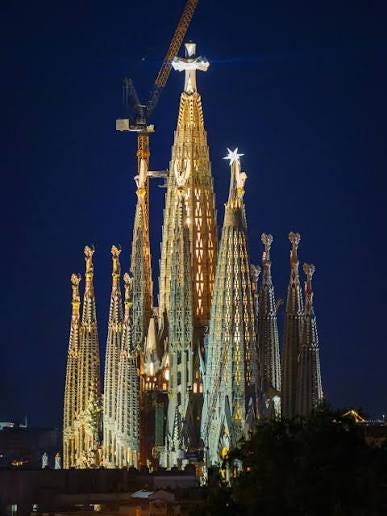
And in between those two days, while everyone was looking up, a pope went to Spain and spent the week looking, so to speak, the other way. He talked about us. About what a human being is.
Nobody filed it under aliens. But it belongs in the same file.
The word he kept saying
He gave something like nineteen talks in seven days, and the rooms could not have been more different. A parliament and a prison. A stadium full of the young and a dock in the Canary Islands where the survivors of the sea come ashore. Cardinals in their red, and men and women just days baptized. You would expect the speeches to scatter in every direction. The didn’t. They kept circling back to one word.
The word was dignity.
You could hear it most plainly in the least likely room. In a prison outside Barcelona, Leo stood among the inmates and reached for a line from his newest and most technical document — his encyclical on artificial intelligence, published only days before — and read it to them as if it were written for that floor and no other. Every person, it says, is worthy “by the mere fact of having been willed, created and loved by God.” An encyclical about thinking machines, read to men the world had mostly given up on. And it fit. It fit perfectly.
He did the same all week. To the parliament he said the dignity of the person “precedes any concession by the State.” On the dock he said “human dignity has no passport.” To artists and professors in Madrid he asked the plainest, hardest question there is: what does it mean to be human?
If you like your proof in numbers, the encyclical itself supplies some. Count the substantial words in it and dignity turns up a hundred times. Only a handful of words beat it, and they are the ones you’d expect — human, good, common, Church — the standing furniture of any letter a pope writes. Move the furniture aside and dignity is what the whole room was built around.
The wrong fear, and the right question
Here is where we usually go wrong.
We hear the words “a higher intelligence” — a machine that thinks faster than we do, a visitor who has crossed the dark between stars — and something in us flinches. As though our worth were a trophy on a shelf, and the next, cleverer thing might walk in and take it down. As though being human were a rank, and we were about to be outranked.
But that was never the claim, and it is worth being clear that the pope is not making it. The faith has never held that we are the cleverest things in creation. Quite the opposite. It has always taught a universe thick with intelligences greater than ours — the angels, and the fallen angels too, the very ones the poor monsignor was fretting about. We were never the top of the ladder. We never needed to be. A brilliant mind arriving from somewhere else would not overturn that picture. It would only fill in a corner of it.
So the question the machines and the spacecraft press upon us is not, in the end, whether we are the smartest thing alive. It is older than that, and more intimate. It is the question you ask when you lie awake: who are we? What is a person worth, and why?
It is a question about identity. And the answer the pope kept giving, room after room, is the one his encyclical gives. We are worthy not for what we can do, but for what we are — and for who we are called to be.
What we are
What we are, first.
For Thomas Aquinas, dignity is not a medal pinned on the person from outside. It is folded into the very meaning of the word. The old definition he inherited and sharpened put it almost shockingly: persona est nomen dignitatis — “person” is a name for dignity. To be a person at all is already to be something of worth. And the root of it is not cleverness or strength or usefulness. It is that we are the kind of creature made, as the first page of Genesis says, in the image of God: able to know, to love, to give ourselves away.
A fine Thomist of the last generation, the Dominican Lawrence Dewan, pressed this down to bedrock, and he did it without a trace of sentimentality. Our dignity, he insisted, is not a warm feeling we have about ourselves. It is a fact — a fact about what we are, about where we stand in the order of things, how near we are to the God who is the source of all that exists. Worth, on this telling, is not earned by being impressive. It is woven into our being.
Dewan also saw the real danger, and it was not a cleverer mind arriving from anywhere. It was a culture that forgets what a human being is. He wrote against the bioethicists of his day who had begun to smudge the line between a man and an animal, who could sit in a university chair and argue, calmly, for infanticide. Lose the sense of what we are, he warned, and the grand word dignity becomes a sound with nothing underneath it. That is the threat. Not the sky. Us.
This, and not any leaderboard of intelligence, is what the encyclical is really about. An age that can build a mind out of silicon is going to be tempted, badly, to measure human beings by the same yardstick it measures machines: speed, output, usefulness, capacity. Leo’s whole letter is a quiet refusal of that yardstick. A person is not a very good machine. A person is a someone, willed and made and loved, and worth does not run on horsepower.
Who we are called to be
And then there is the second half, the part that lifts the whole thing.
We are not only made. We are called.
Strip the spectacle from the alien movies and the ache underneath them is not really a hope for company. It is a hope to be told that we matter — that someone will come down out of the sky and reveal, at last, who we are. It is telling that Spielberg’s film is called Disclosure. The word means an unveiling, a revelation.
But the revelation already came, and it did not arrive on a ship. The Christian claim is that the One who made us came down himself and took up our nature — not to inform us from a distance that we have value, but to do something far stranger and more tender: to make us his children. “To all who received him he gave power to become children of God.” Our worth was spoken at our creation and raised past all telling in our adoption. We do not need visitors from another world to certify it. The certificate was issued in Bethlehem.
The longing in all those stories is real; it is just already answered, and from closer than the stars. Tolkien once told a doubting Lewis, on a midnight walk in 1931, that the old myths of a god who comes down and dies and rises were not lies but “good dreams” — rumors of a thing that would, just once, actually happen. Whether or not there is anyone out there among the galaxies changes none of this. If there is, they are creatures like us, perhaps in want of rescue themselves. What they could never be is our makers, or our saviors, or the source of a worth that was never theirs to give.
What he was really doing in Spain
Seen this way, the trip stops looking like a victory lap, though it was a triumph, and starts looking like a single, patient argument made in homilies.
The prison was the argument about what we are: that no failure unmakes it. The parliament was the argument that this worth comes before the State and cannot be voted away. The dock in the Canaries — “human dignity has no passport” — was the argument that it was never issued by any earthly power, and so cannot be revoked by one. Even the night the pope sat with the young and a boy spoke about wanting to die, and Leo would not dress the pain up as God’s will but said plainly that God does not want it — even that was the same argument: that a life which cannot perform is not a life without worth.
There is a last touch, and the pope left it for whoever was paying attention. The encyclical is called Magnifica Humanitas, “magnificent humanity,” and the name is built to echo the Magnificat, the song of a young woman that the lowly are lifted up and the mighty pulled down from their thrones. The week in Spain was, from one angle, her pilgrimage from start to finish — a golden rose laid before Our Lady in Madrid, the rosary at Montserrat. It is the right frame for a man insisting, all week long, that greatness is not where the world keeps looking for it.
So the next time the sky fills up with rumors, the question to put to ourselves is not whether we are alone. We never thought we were. The question is the one the pope carried quietly across Spain while the rest of us stared upward, waiting for ships. Not who is the highest mind in the universe.
Who we are. And whose.
Thank you for tying these two together and making our Pope’s trip in perspective.
Do you believe the people of Spain will be helped as well? For this country to be so non-church going is a tragedy.