

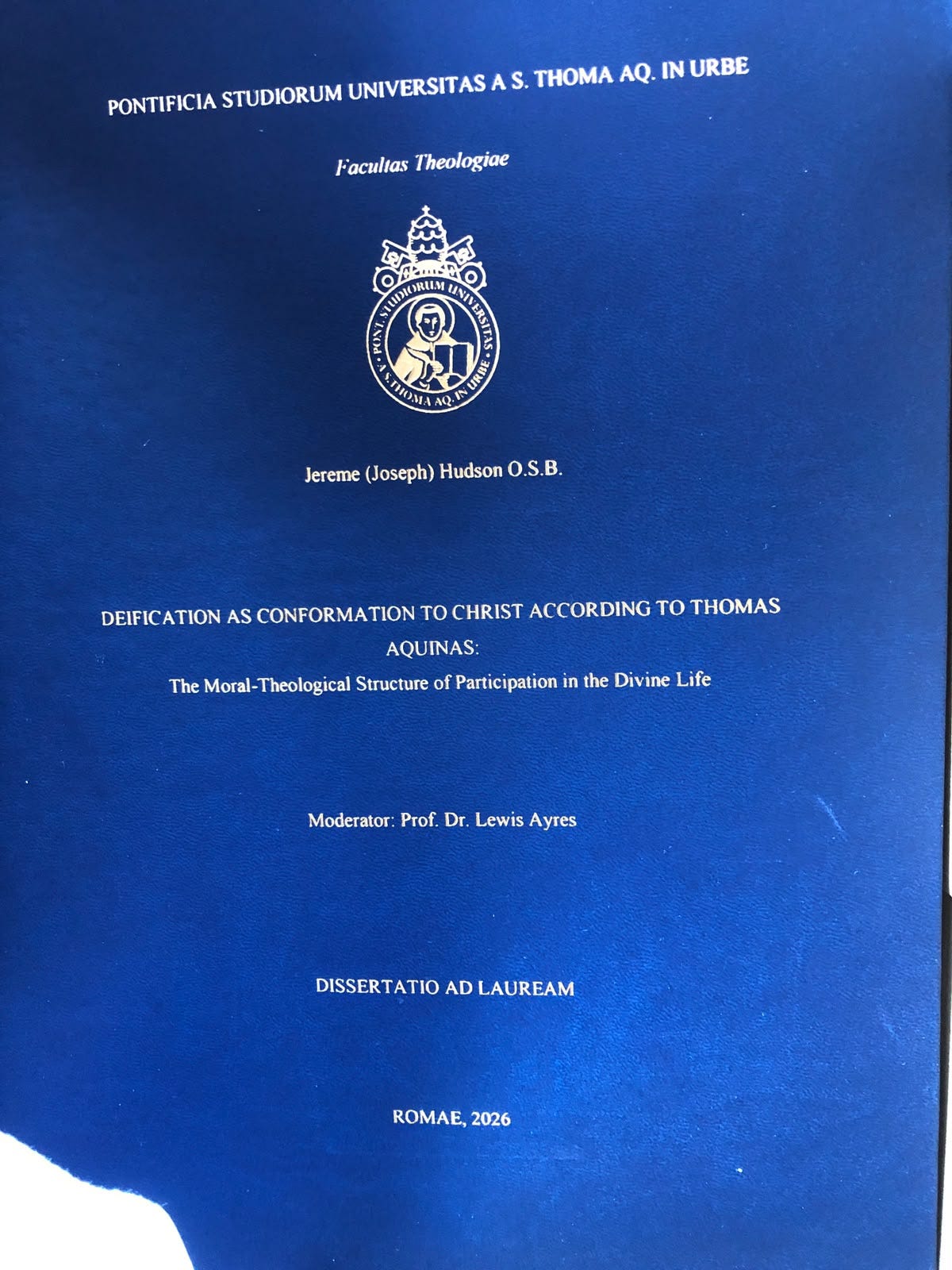
Yesterday I picked up the printed copies of my doctoral thesis.
Seeing them bound was stranger than I expected. For the last few years, “the thesis” had been a collection of Word files, books piled around my desk, notes in margins, half-finished paragraphs, footnotes I could never quite finish checking, and chapters that always seemed to need one more revision.
Now there were several blue volumes sitting in a cardboard box.
Daniel and I sat down to look through them. He flipped through one for a while, stopped at a few pages, and finally looked up.
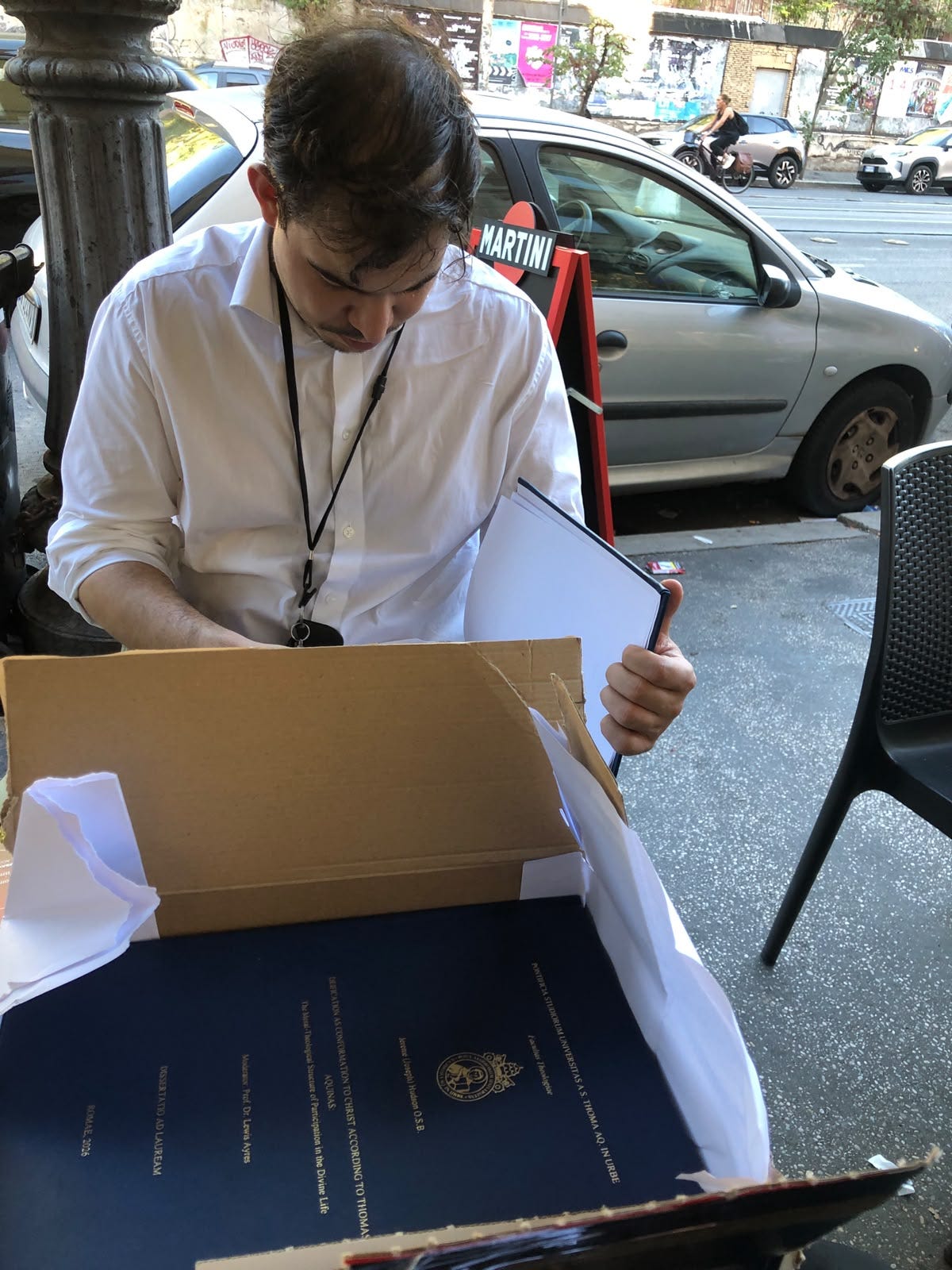
“Looks great! I don’t understand anything you are saying, but it looks really good!”
Fair.
But his comment did make me wonder: after all these years…I have learned how to say something precisely…now, can I say it simply?
What did I spend 350 pages really trying to say?
Basically this:
God does not just hold up Christ as an example and tell us to imitate him. Grace actually changes us. It makes us like Christ, so that through him we can share in the life of God.
The old Christian word for this is deification.
It’s a startling word. It can even sound dangerous, heretical. In fact, I have encountered more than a few puzzled expressions during my prior attempts to explain the thesis to friends. If they are polite, they often simply remain silent. The more salty will challenge me with something like, “ah that must be something for the illuminati,” or, “so I guess it wasn’t written for the layman.” While the intellectually curious often confront me with a simple, “what’s that?!?”
Put simply, deification does not imply that Christians stop being human or somehow turn into little Asgardians. We remain creatures, and all too fallible creatures at that.
But God intends more for us than simply making us into superheroes, still less does he intend to simply make us into “decent people.” God does not need a classroom of good little boys and girls.
Above all God wants to give us His life, a share in his own wild and strange happiness.
And that immediately raises the question I eventually spent most of the thesis trying to answer: what does that actually look like?
The answer, I came to think, is Christ.
That sounds obvious. Perhaps it should be obvious. But it makes a considerable difference.
Christ is more than someone standing in front of us saying, “do what I do,” “say what I say,” “think as I think.” The Christian is someone who becomes plugged into the same engine of inspiration that permeated Christ’s entire life. We are joined to Christ through the power of the Holy Spirit. And while his life truly does become the pattern of ours, it also becomes uniquely ours, and even takes on wholly unforeseen manifestations.
And this is where a lofty idea like “sharing in the divine life” suddenly becomes very ordinary.
Rather than relating to grand ambitions to bring peace to the world, or restore health to the global environment, it has more to do with how and what I love. With how I make a decision. With whether I tell the truth. With what I do when I am angry. With whether I forgive. With whether I can suffer without becoming bitter. With how I pray.
If grace is real, it eventually has to show up here, there and everywhere.
That is one reason I became so interested in the word conformity.
It is not a very attractive word today. Nobody wants to be told to conform. It sounds like everyone being pressed into the same mold and coming out looking alike. Even historically, to be a conformist was to be a member of the Church of England, to deny the Catholic faith. Many Irish and English Catholics of the 17th and 18th century took pride precisely in being labeled as recusants and non-conformists.
But this is a political and social usurpation of an idea that was principally a theological and spiritual one, an idea that can only make sense when attributed to the principles of our own nature.
So if you want examples of what St Paul means when he says that God has predestined us to be conformed to image of His Son (Rom. 8:29), don’t look at political figures, look at the saints.
Francis does not become less like Francis by becoming more like Christ. Nor does Benedict become like Francis. And certainly Thérèse never became anything like Thomas Aquinas. Yet, they all became more recognizably themselves, even as they became more recognizably like Christ.
That struck me.
The closer the saints come to Christ, the less interchangeable they seem to be.
Grace does not erase the person. It perfects her.
That may be the part of the thesis I care about most.
Christian holiness is not God taking the person he made and replacing her with somebody else. It is God bringing that person to a perfection she could never have reached by herself.
And the face of that perfection is Christ.
The Father makes us His sons in the Son. The Holy Spirit works within us so that Christ’s spirit becomes our spirit: to enter into the way we think, choose, love, pray, and live. Slowly we put off the old man and begin to be transformed by the renewal of our minds (Romans 12:2).
That is more or less the thesis.
There are 350 pages of distinctions, arguments, Latin phrases, Greek words, objections, footnotes, and qualifications behind those few paragraphs. Some of them are necessary. Some may even be interesting.
But I am glad to discover that the basic idea can still be said without them.
Finishing the thesis has also been humbling. I know much better now where the argument is incomplete than I did when I began. There are things I would rewrite. Questions I would pursue further. Probably a few footnotes I would prefer never to see again.
Mostly, though, I am grateful.
I had very good teachers. I spent several years in the company of St. Thomas and a great many other thinkers, living and dead. And I had the privilege of spending a rather ridiculous amount of time thinking about a question that matters far beyond the university:
What does God want to do with a human life?
My answer, after all these pages, is that he wants to make it look like Christ.
Daniel still may not understand the dissertation.
I can’t really blame him.
But perhaps I can explain it now.
Congratulations! We give thanks and glory to God for the gift of your priesthood.
Thank you, Fr. Joseph, for sharing this wonderful moment with us. Congratulations on completing this important work. Can’t wait to hear more.